
The UK continues to face a fast-evolving cyber threat landscape. Proofpoint® researchers have observed phishing activity rising faster in the UK than across Europe and globally, alongside highly effective targeted cloud attacks, evolving espionage activity, and cybercriminal campaigns tailored specifically to UK organisations and individuals.
Key findings
- Phishing detections are rising faster in the UK than across Europe and globally. Detections increased 5.7× year-over-year in the UK, compared with 4.5× across Europe and 1.5× worldwide.
- Some UK sectors face particularly concentrated email threats. Higher education is the UK’s most-targeted sector for phishing, while malware targeting UK manufacturing increased 198% year-over-year.
- Targeted cloud attacks are proving highly effective. Precision attacks - including techniques such as phishing and session hijacking - impacted 71% of targeted UK organisations, compared with 34% for broader brute-force attacks.
- Espionage actors continue to target UK interests. Proofpoint researchers have observed TA446 targeting UK individuals and organisations using techniques spanning credential phishing, desktop malware, and mobile exploitation.
- Cybercriminals are tailoring campaigns to UK targets. Threat actors are impersonating familiar investment platforms and recruitment firms, while UK transportation and logistics organisations remain targets for campaigns that can enable real-world cargo theft.
Phishing detections surge in the UK
Email remains a critical attack vector for UK organisations. Proofpoint data shows phishing detections increased 5.7× year-over-year in the UK, compared with 4.5× across Europe and 1.5× worldwide (October 2025-October 2026). The increase significantly outpaced overall UK email volume, which grew 1.5× during the same period.
Some sectors face particularly concentrated threats. Higher education is the UK’s most-targeted sector for phishing, with universities receiving 3.2× the UK average. Malware and business email compromise (BEC) are also disproportionately high in the sector. The sector also saw a click rate of 17 per 100 delivered threats, which is more than twice the UK average.
UK manufacturing is seeing a different trend. Malware targeting manufacturers increased 198% year-over-year, despite malware declining 19% across the UK overall. Manufacturers also experienced phishing at 2.5× and BEC at 2.2× the UK average.
Meanwhile, UK construction stands out for telephone-oriented attack delivery (TOAD), or callback phishing. Construction firms received these threats at 2.2× the UK average, with common lures including fake invoices and payment-change requests designed to target finance and procurement teams.
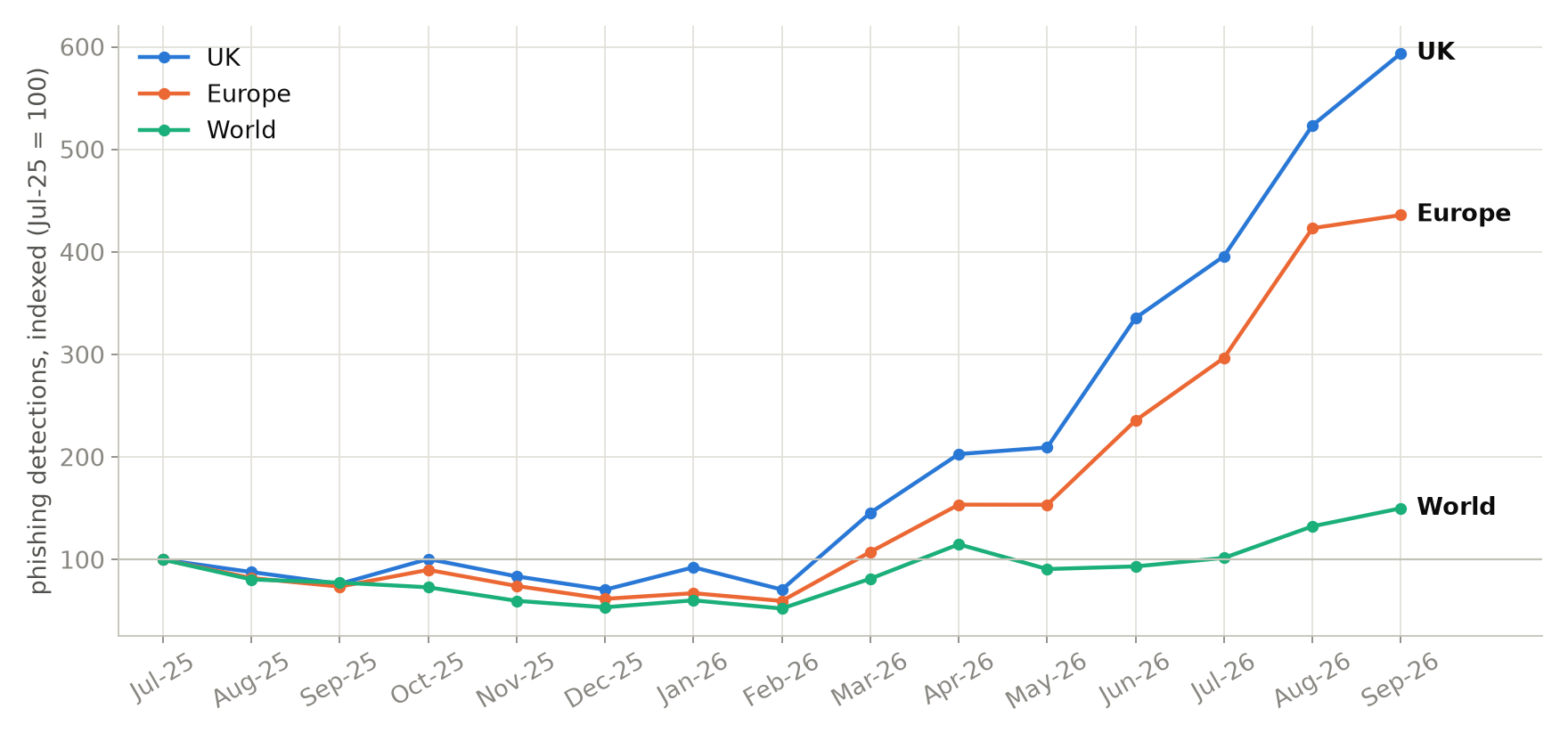
Figure 1: Phishing detections in the UK, Europe, and globally.
Targeted attacks expose UK cloud environments
Cloud-based attacks are widespread, with 99% of UK organisations observed as targeted and 72% showing evidence of successful compromise.
Precision attacks are proving particularly effective. Unlike broad brute-force techniques such as password spraying, precision attacks use more targeted methods - including phishing and session hijacking - to compromise specific users and accounts. These attacks impacted 71% of targeted UK organisations, compared with 34% for brute-force attacks. The impact was also higher than across Europe, where 64% of organisations targeted by precision attacks were impacted.
Once access is gained, attackers frequently seek to extend or maintain it. Proofpoint observed post-access activity at 69% of UK organisations, including MFA manipulation, suspicious mailbox rules, file activity, and abuse of compromised mailboxes.
Espionage actors maintain their focus on UK targets
Proofpoint researchers continue to observe state-aligned threat actors targeting UK interests. TA446, a Russia-aligned espionage actor also known as Callisto, has targeted individuals with expertise in Ukraine and Russia, including current and former government figures, as well as individuals and financial organisations potentially involved in providing financial support to Ukraine.
The actor demonstrates a broad range of capabilities. Proofpoint has observed TA446 using credential phishing and desktop malware against UK targets, as well as DarkSword, an iOS exploit kit, demonstrating its ability to target victims across both desktop and mobile environments.
Cybercriminals tailor campaigns to UK targets
Cybercriminals continue to target UK organisations and individuals with highly tailored campaigns spanning financial fraud, credential theft, malware, and social engineering.
TA2730, a prominent credential phishing actor, targeted UK investment platforms at a near-continuous pace from January through late October 2026. Campaigns impersonated well-known platforms including Hargreaves Lansdown, Trading 212, Saxo, AJ Bell, and Interactive Investor, typically using tax form renewal lures to steal credentials.
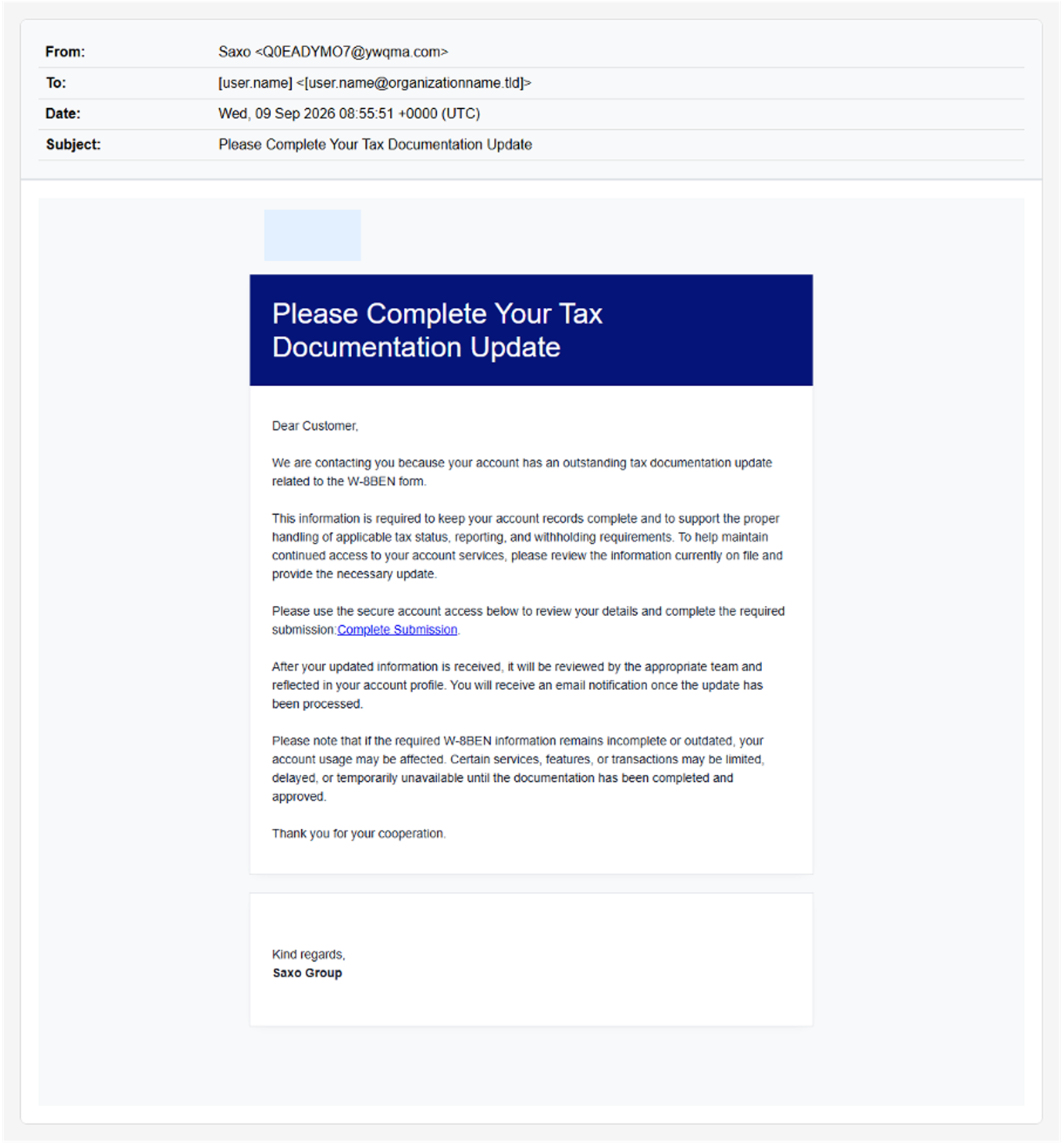
Figure 2: TA2730 email lure.
The actor uses a real-time phishing kit, with a live operator monitoring victims as they enter their credentials. This enables stolen login details and multi-factor authentication codes to be used before they expire, potentially giving attackers access to investment and brokerage accounts and creating opportunities for fraudulent transfers, withdrawals, or liquidation of investments.
Other cybercriminal actors are also targeting the UK. TA4922, a Chinese-speaking threat actor primarily focused on the Asia-Pacific region, conducted high volumes of malware and credential phishing campaigns against UK organisations between March and May 2026. Its campaigns used multiple malware families alongside techniques including WhatsApp impersonation and malicious URLs.
Meanwhile, initial access broker TA586 has targeted UK users with fake job and interview opportunities. The actor begins with benign conversations and, when a target responds, follows up with a URL designed to install malware.
Cybercrime targeting the UK can also have physical-world consequences. Proofpoint continues to observe transportation and logistics organisations among the targets of campaigns delivering remote access tools. Once freight organisations are compromised, criminals can potentially use that access to fraudulently bid on cargo shipments that are subsequently stolen and resold. UK losses from cargo crime reportedly reached £65.1 million in 2025 (NaVCIS, August 2026).