 uk:
English: Europe, Middle East, Africa
uk:
English: Europe, Middle East, Africa

















Cybersecurity has always been a race—but that race is being fundamentally redrawn.
Frontier AI models like Mythos and Daybreak are accelerating vulnerability discovery and exploit development at unprecedented speed, compressing timelines from months to hours. At the same time, organizations are overwhelmed by growing volumes of critical vulnerabilities while traditional prioritization frameworks struggle to keep pace with real-world attacker activity.
The result is a rapidly widening gap between AI-speed exploits and human-speed defenses.
According to the 2026 Verizon Data Breach Investigations Report, vulnerability exploitation now accounts for 31% of all breaches—the first time in 19 years it has surpassed stolen credentials as the leading initial access vector. Meanwhile, the report states that the median time to patch critical CISA Known Exploit Vulnerabilities (KEVs) has gone up from 32 to 43 days, while threat actors are already leveraging GenAI across more than 15 attack techniques.
Nearly 30% of vulnerabilities are weaponized within 24 hours1, yet patch cycles still take weeks or months. Even more concerning, recent research found that the average time-to-exploit is now approximately negative seven days2, meaning attackers are exploiting vulnerabilities before patches are even released.
Together, these trends are leaving defenders struggling to keep up with attackers operating at machine speed.
The New Reality: Faster Exploits, Slower Defenses
Three converging forces are driving today’s exposure crisis:
1. AI-accelerated exploit development
Frontier AI is dramatically compressing the timeline from vulnerability discovery to weaponization. Every new feature, integration, or system becomes a potential attack surface—and AI enables adversaries to find and exploit weaknesses faster than ever.
2. Traditional Prioritization Models Are Falling Behind
Exploit timelines are shrinking dramatically. Public exploits often appear before official advisories, leaving defenders with little time to react. Security teams continue to rely heavily on severity scores and theoretical exposure models to determine what matters most. But high CVSS scores do not necessarily reflect active exploitation.
Organizations need to know what attackers are targeting in the real world—not just what appears severe on paper.
3. Overwhelming volumes of critical findings
Tens of thousands of new CVEs are published each year, with many rated “high” or “critical.” Yet security teams cannot realistically patch everything immediately.
Without clear signals about real attacker behavior, organizations are forced to choose between acting on incomplete intelligence or falling behind entirely, leading to delayed remediation, increased breach risk, and operational disruption.
What Success Looks Like in the Age of AI-Driven Threats
To keep pace with AI-speed adversaries, organizations must adopt a fundamentally different approach—one that disrupts exploit-driven attacks earlier in the attack chain.
That means shifting from theoretical risk scoring to real-world exploit intelligence and immediate protection.
Prioritize based on real adversary activity—not theoretical risk
Traditional scoring systems alone are no longer enough. Security teams need to focus on vulnerabilities that are actively exploited in the wild, not just those that appear severe on paper.
Stop Exploit-Driven Attacks Before Execution
Organizations need real-time visibility into exploit delivery attempts—before payload execution, endpoint compromise, or lateral movement occurs.
Get immediate protection during the patch gap
Patching takes time. Defense cannot wait. Organizations need continuously updated protection that reduces exposure while remediation is underway.
Operationalize Intelligence Across Existing Workflows
Exploit intelligence must integrate directly into existing tools, workflows, and emerging AI-driven security operations to enable faster, more confident decisions.
Introducing Proofpoint Active Exploits Protection
Today, we’re introducing Proofpoint Active Exploits Protection—a new approach designed to help organizations identify and stop exploit-driven attacks before execution.
What fundamentally differentiates Active Exploits Protection from traditional endpoint, network, and exposure-management solutions is its ability to provide best-in-class first-mile exploit protection through visibility into email—the primary entry point for many modern attacks.
Powered by visibility across more than 2 trillion annual email messages and a global sensor network, Proofpoint sees real attacker behavior as exploits are being delivered. This enables organizations to identify exploit activity at the earliest stage of the attack chain—before payload execution, endpoint compromise, or lateral movement occurs.
While endpoint, network, and exposure-management vendors prioritize vulnerabilities after discovery, Proofpoint sees actual adversary intent through live attack telemetry. This provides organizations with earlier, higher-confidence insight into the threats attackers are actively attempting to exploit right now.
Key capabilities and benefits
1) Best-in-Class First-Mile Exploit Protection
Proofpoint delivers best-in-class first-mile exploit protection by identifying and preventing exploit activity at the email front door. This matters because many modern attacks begin with exploit delivery through email.
By observing exploit attempts in real time across both email and network telemetry, Proofpoint provides earlier visibility into attacker behavior and active exploit campaigns than traditional endpoint or downstream detection approaches. This enables security teams to reduce exposure faster and act before compromise spreads.
2) Prioritize What Attackers Are Actually Targeting
Active Exploits Protection helps security teams prioritize vulnerabilities based on real-world attacker activity rather than theoretical severity scores alone.
By correlating exploit intelligence, network telemetry, and observed attacker behavior, organizations can focus remediation efforts on the vulnerabilities most likely to be exploited.
This reduces operational noise, improves prioritization confidence, and helps security teams focus resources where they matter most.
3) Immediate Protection During the Patch Gap—Not Just Insight
Insight alone doesn’t reduce risk. Action does.
Active Exploits Protection enables immediate protection through network- and email-based threat detection that can be deployed as soon as threats emerge. It delivers continuously updated network-based rulesets that integrate with existing infrastructure, including IDS, IPS, and NGFW, to help organizations reduce exposure during the patch gap.
For Proofpoint customers, the exploit intelligence from Active Exploits Protection also enhances the threat detection capabilities within Proofpoint Core Email Protection, strengthening defenses against exploit-driven attacks delivered through email.
By extending protection across both network and email vectors, organizations can reduce exposure earlier while minimizing operational disruption.
4) Make Faster, Threat-Informed Decisions
By enriching your security stack with real-time global threat intelligence and high-fidelity threat detection, Active Exploits Protection enables faster, more confident decision-making. Actionable insights on malicious IPs, domains, malware, and campaigns are integrated directly into existing tools, allowing teams to prioritize and respond quickly. Continuous updates and reputation scoring ensure threat intelligence is always current, while reduced noise—like false-positives—improves overall effectiveness. Through flexible APIs, organizations can tailor exploit intelligence to their own workflows and operational priorities.
5) Scale and Streamline Operations with AI-Driven Workflows
Active Exploits Protection is designed to support modern, intelligence-driven security operations by enabling seamless integration with AI- and API-powered workflows. By embedding prioritized threat intelligence directly into automated processes, teams can accelerate decision-making and reduce manual triage. Emerging capabilities, including MCP and agent-based workflows, further streamline how intelligence is accessed and applied. This helps organizations keep pace with rapidly evolving threats.
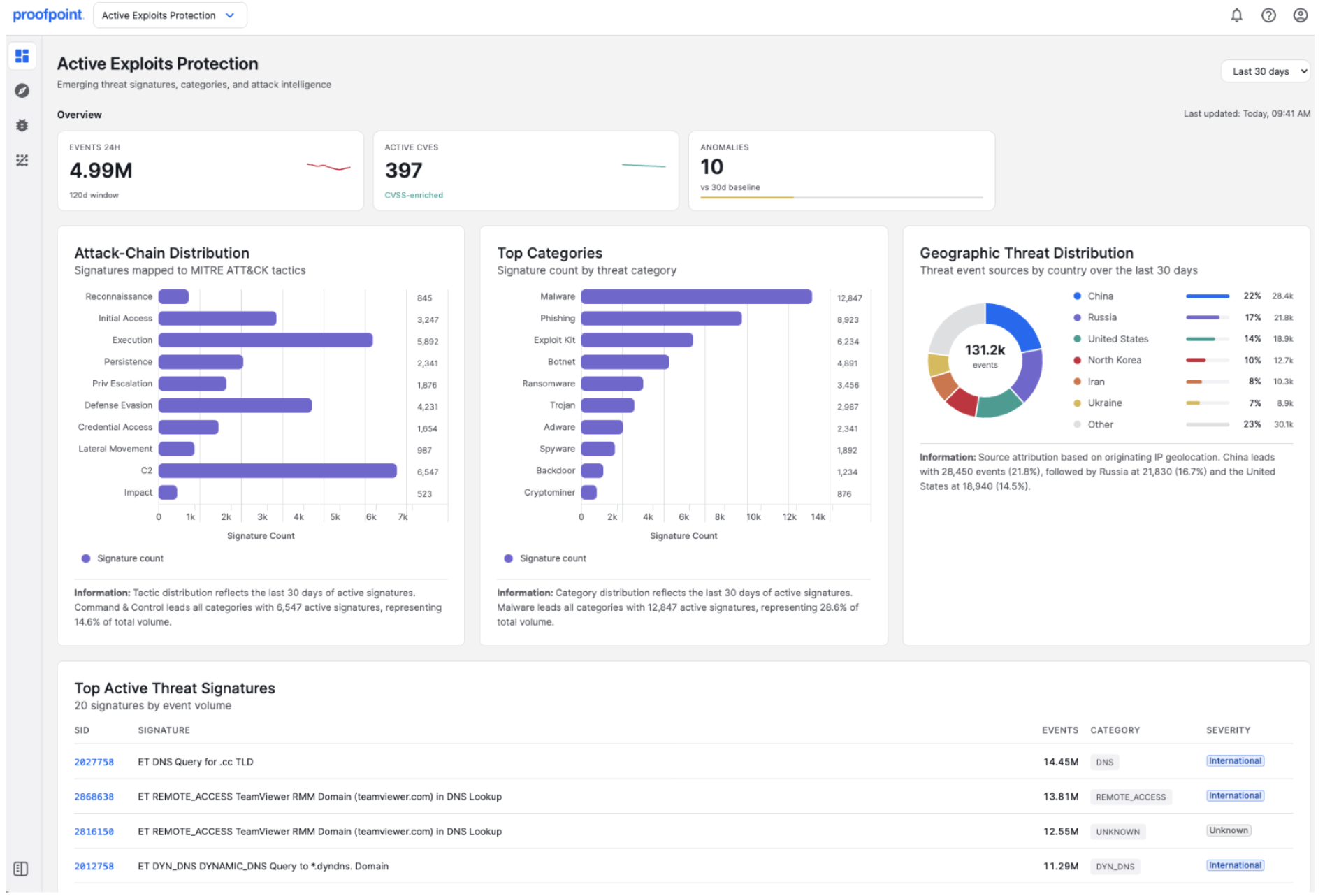
Figure: Proofpoint Active Exploits Protection helps organizations reduce exposure faster with prioritized vulnerabilities and immediate protection.
Conclusion: A New Standard for Exposure Reduction
As exploit development accelerates in the age of AI, organizations need more than vulnerability prioritization—they need the ability to identify and stop exploit-driven attacks before execution.
Proofpoint Active Exploits Protection represents a shift from reactive vulnerability management to proactive, threat-informed exploit protection. It delivers best-in-class first-mile exploit protection powered by real-world adversary telemetry across email and network traffic. By combining exploit intelligence, prioritization, and immediate protection into a unified operational approach, organizations can reduce exposure faster, improve operational focus, and respond to exploit-driven threats with greater confidence.
The future of exploit protection belongs to organizations that can see and stop attacks earlier in the attack chain—and that’s exactly what Proofpoint is built to do.
To learn more about Proofpoint Active Exploits Protection—what it is, why it matters—check out our press release and website.