
Key takeaways
- Frontier AI puts machine-speed attacks in every adversary's hands
- A single campaign can now be rewritten with infinite variants
- AI has made perfecting and distributing the “perfect lure” cheap.
- The inbox is becoming a machine-speed workflow trigger.
- Seconds now separate delivery from compromise.
The shift
For most of the last decade, one thing quietly worked in the defender’s favor: building a convincing lure took skill, time, and effort. Researching a target, writing clean and localized copy, and standing up believable infrastructure limited how fast strong attacks could arrive and how many there could be.
Frontier AI removes that limit. Anthropic’s Claude Mythos Preview—a model the company has limited due to its offensive security capabilities—can read code, find unknown flaws, and write working exploits with little human direction. Across its Project Glasswing partners, it has already helped surface more than 10,000 high- and critical-severity vulnerabilities. Anthropic expects other labs to field comparable models within six to 12 months.
For anyone defending the inbox, the result is simple. The lure that used to take a skilled operator days can now be produced, personalized, and sent in seconds, at a volume no human team could match. These attacks were always possible. Now they are cheap, fast, and effectively unlimited.
Email is the first place agents went to work
Email is high volume, repetitive, and entirely text-based—a natural fit for a virtual assistant, and one of the first places people readily handed everyday work to AI. That help has arrived in a clear progression, from reading to drafting to acting:
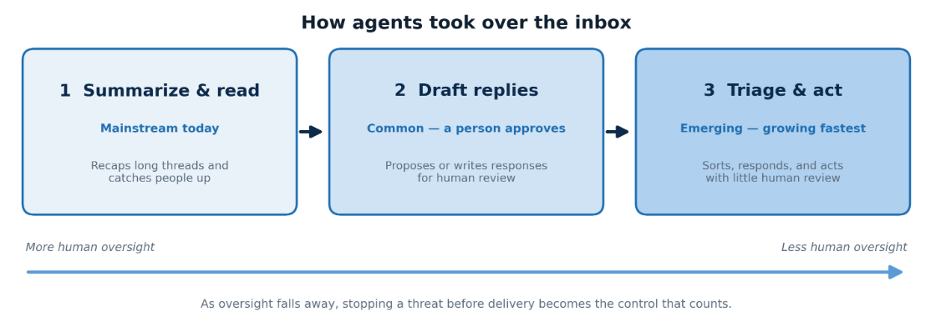
Figure 1. As AI agents gain autonomy, email workflows are increasingly shifting from human review to automated action.
The numbers behind this shift are striking. Microsoft now reports more than 20 million paid Microsoft 365 Copilot seats, up from 15 million in January, and says weekly Copilot engagement has reached the same level as Outlook. Gartner expects task-specific AI agents to be built into 40% of enterprise applications by the end of 2026, up from under 5% a year earlier. Its 2026 CIO survey found that only about 17% of organizations have deployed agents so far, but more than 60% plan to within two years.
This is what matters for security. Each step in that progression removes a little of the human pause that could have caught an attack. When an agent reads and acts on a message, that hesitation is gone. The email no longer has to fool a person at all. It can carry instructions written for the agent, meant to be acted on before any human gets the chance to see them. The inbox is becoming an input to systems that move at machine speed, and the one place you can still step in is before delivery.
Cleanup after delivery can’t keep pace
Post-delivery remediation (pulling a malicious message back out of the inbox once it’s flagged) made more sense when attacks took time to arrive and people took time to act. There was wiggle room in the timeline.
Now, that room is gone. When an attacker can generate and deliver a flawless lure at machine speed, the gap between delivery and the first click closes to seconds. By the time a retraction runs, the credential may already be entered and the session already compromised. Remediation still has a role, but as a primary control it is chasing a threat it can’t catch.
The point is clear: protection that acts only after a message reaches the inbox is always a step behind and that delay is exactly what the attacker is counting on.
Even API-first vendors are moving inline
Vendors that built their entire approach on post-delivery, API-based response—analyzing mail only after it lands in Microsoft 365 or Google Workspace—are now adding inline protection of their own. Inline means inspecting and deciding on a message inside the delivery path and rendering a verdict before it ever reaches the inbox, rather than reacting once it has landed.
That move isn’t a passing trend. It’s an admission. Once milliseconds decide the outcome, anything that acts post-delivery is too late. The post-delivery strategy itself no longer fits the threat. The market is converging on pre-delivery protection because nothing else keeps up.
Proofpoint Core Email Protection has worked in the delivery path for years. It runs inline—by gateway or API—to render a verdict before a message reaches a person, not after the damage is already in motion.
Email is still where it matters
Email matters more than almost any other channel for one more reason: it is the most visible control a company has. When it fails, everyone knows. A malicious message in an executive’s inbox isn’t a buried log entry; it’s a call from the top floor. That visibility makes email both a constant target and a constant priority—and one that’s easier to fund, because leaders can see exactly what a failure costs them. And the highest-value inboxes are exactly the ones an AI-assisted attacker can now imitate convincingly.
What pre-delivery protection must do now
Stopping an AI-generated threat before delivery takes more than the reputation lists and signatures that frontier tooling renders stale the moment they’re published. It takes:
- A verdict before delivery. Every message must be inspected and decided on inside the delivery path, before it reaches a person.
- Detection that reads intent, not artifacts. AI-written lures may have no typos, reused templates, or familiar fingerprints, so defense must weigh behavior, relationships, and context.
- Pre- and post-delivery as one system. Pre-delivery protection stops the vast majority of threats before harm is possible; post-delivery protection catches what only later context reveals. The goal isn’t to drop remediation, but to stop treating it as the front line.
- Speed as a requirement, not a tradeoff. Protection that adds delay or fails under load is protection an attacker can outrun.
This is where Proofpoint is headed. On June 30, 2026, Proofpoint is unifying its two market-leading approaches—secure email gateway (SEG) and API-based protection—into a single, integrated model that operates as one coordinated system across the email lifecycle. The gateway renders a verdict before delivery, stopping threats at the perimeter before they reach a person, while API-based protection extends coverage to post-detection and the internal, mailbox-to-mailbox traffic that perimeter controls never see.
Critically, the two layers share detection intelligence, so a threat surfaced post-delivery sharpens the next pre-delivery decision. Security teams get one console, one investigation workflow, and one set of policies instead of stitching point products together. In a world where threats arrive faster than analysts can switch dashboards, that’s what keeps defense moving at the speed of the attack.
The time to act is now
Email threats aren’t new. What’s new is that Mythos, and the tools following it, have stripped away the friction that kept them manageable. As attacks arrive faster, cleaner, and at greater scale, the question is no longer how quickly you can clean up after one lands. It’s whether you can keep it from landing at all. That is the standard to hold your email security to now, and it’s where Proofpoint helps customers stay ahead.
Watch the Proofpoint AI Security Summit on demand.
Read our blog announcing the SEG + API product unification.