
Key findings
- Between March and June 2025, Proofpoint Threat Research observed three Chinese state-sponsored threat actors conduct targeted phishing campaigns against the Taiwanese semiconductor industry. In all cases, the motive was most likely espionage.
- Targets of these campaigns ranged from organizations involved in the manufacturing, design, and testing of semiconductors and integrated circuits, wider equipment and services supply chain entities within this sector, as well as financial investment analysts specializing in the Taiwanese semiconductor market.
- This activity likely reflects China’s strategic priority to achieve semiconductor self-sufficiency and decrease reliance on international supply chains and technologies, particularly in light of US and Taiwanese export controls.
Overview
Analyst note: Proofpoint uses the UNK_ designator to define clusters of activity that are still developing and have not been observed for long enough to receive a numerical TA designation.
China-aligned threat actors have routinely targeted the semiconductor industry for many years. This activity likely aligns with China’s internal strategic economic priorities, which have increasingly emphasized the importance of semiconductor technologies in successive national economic development initiatives, including the Five-Year Plans. A growing focus on ensuring strategic self-reliance for semiconductor technologies, accelerated by external pressures from export controls, has likely reinforced the priority of intelligence collection operations directed at this industry. This is reflected in China-aligned espionage activity tracked by the Proofpoint Threat Research team, where we are currently observing an elevated level of targeting of the industry by China-aligned groups compared to historical activity.
Between March and June 2025, Proofpoint identified multiple China-aligned threat actors specifically targeting Taiwanese organizations within the semiconductor industry. This included a China-aligned threat actor tracked as UNK_FistBump targeting semiconductor design, manufacturing, and supply chain organizations in employment-themed phishing campaigns resulting in the delivery of Cobalt Strike or the custom Voldemort backdoor.
Additionally, Proofpoint observed another China-aligned threat actor tracked as UNK_DropPitch targeting individuals in multiple major investment firms who specialize in investment analysis specifically within the Taiwanese semiconductor industry. This UNK_DropPitch targeting is exemplary of intelligence collection priorities spanning less obvious areas of the semiconductor ecosystem beyond just design and manufacturing entities. Finally, we also observed an actor tracked as UNK_SparkyCarp conducting credential phishing activity against a Taiwanese semiconductor company using a custom Adversary in the Middle (AiTM) phishing kit.
UNK_FistBump targets semiconductor manufacturing and supply chain with job seeking lures
In May and June 2025, Proofpoint observed UNK_FistBump conducting multiple spearphishing campaigns targeting Taiwan-based semiconductor manufacturing, packaging, testing, and supply chain organizations. Posing as a graduate student seeking employment, the actor used compromised Taiwanese university email addresses to send their phishing email to recruitment and HR personnel. Subject lines observed across this activity include the following:
- 產品工程(材料分析/製程優化)-台灣大學-薛豪 [附履歷] (Machine Translation: Product Engineering (Material Analysis/Process Optimization) - National Taiwan University - Xue Hao [with resume])
- Bumping工程師-台灣大學-材料工程學類-薛豪 (Machine Translation: Bumping Engineer-National Taiwan University-Material Engineering-Xue Hao)
- 【重要】麻煩協助確認 (Machine translation: [Important] Please help confirm)
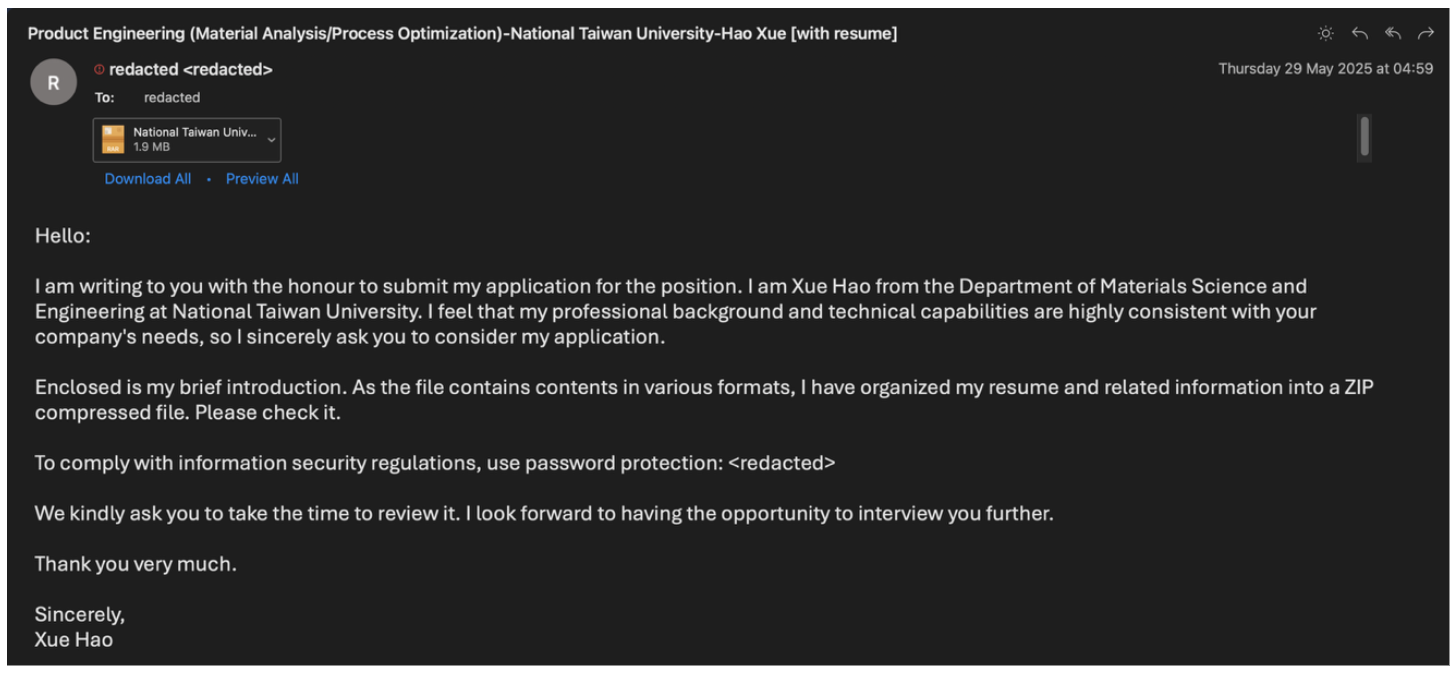
Example UNK_FistBump job application phishing email (machine translated from Traditional Chinese).
Delivery
UNK_FistBump phishing emails were sent via a likely compromised account and contained either a password-protected archive attachment or a PDF attachment. The PDF attachments contained URLs leading to an archive file hosted on either a Zendesk instance or the Filemail file sharing service. Earlier UNK_FistBump campaigns delivered a Cobalt Strike Beacon payload, but the group shifted to delivery of the custom Voldemort backdoor in late May 2025.
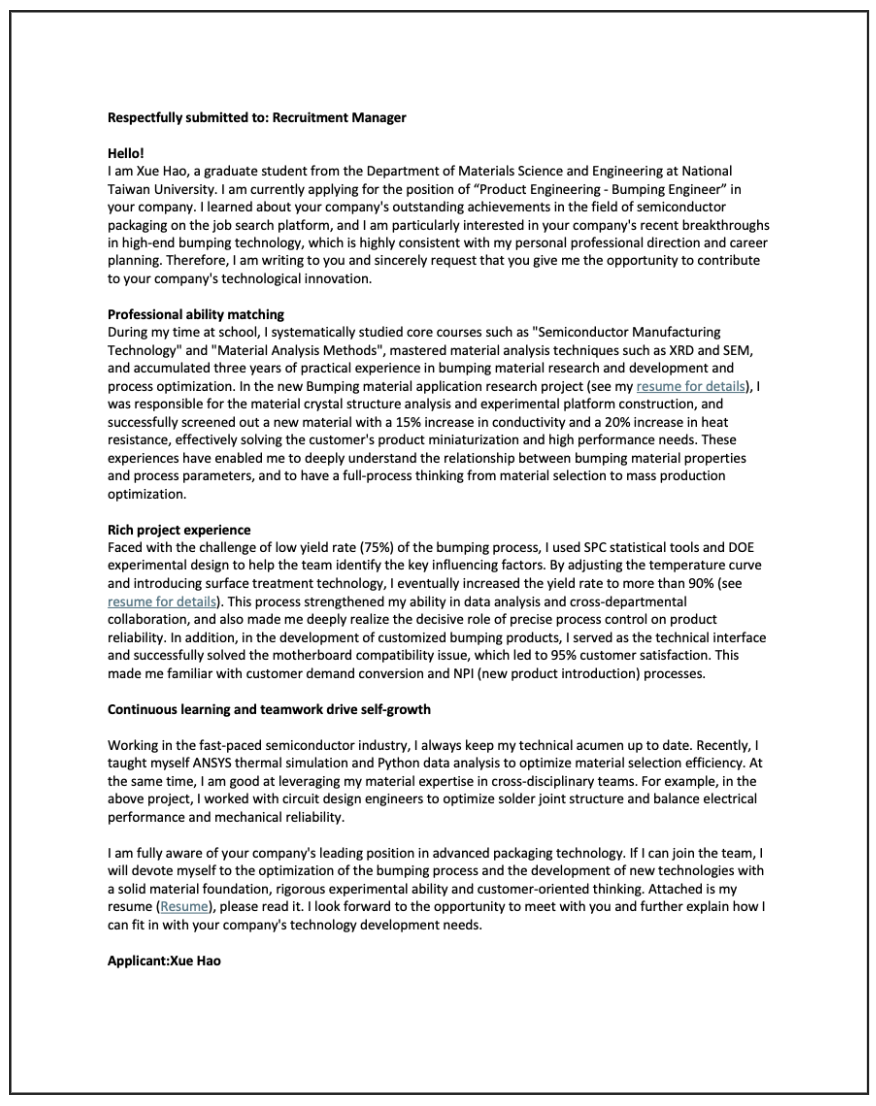
UNK_FistBump PDF attachment leading to file sharing site (machine translated from Traditional Chinese).
In an unusual campaign in late May 2025, UNK_FistBump included two distinct infection chains beginning with the same password-protected archive, one of which loaded a Cobalt Strike Beacon payload, and the second loading Voldemort. These infection chains were initially triggered by distinct Microsoft Shortcut (LNK) files.
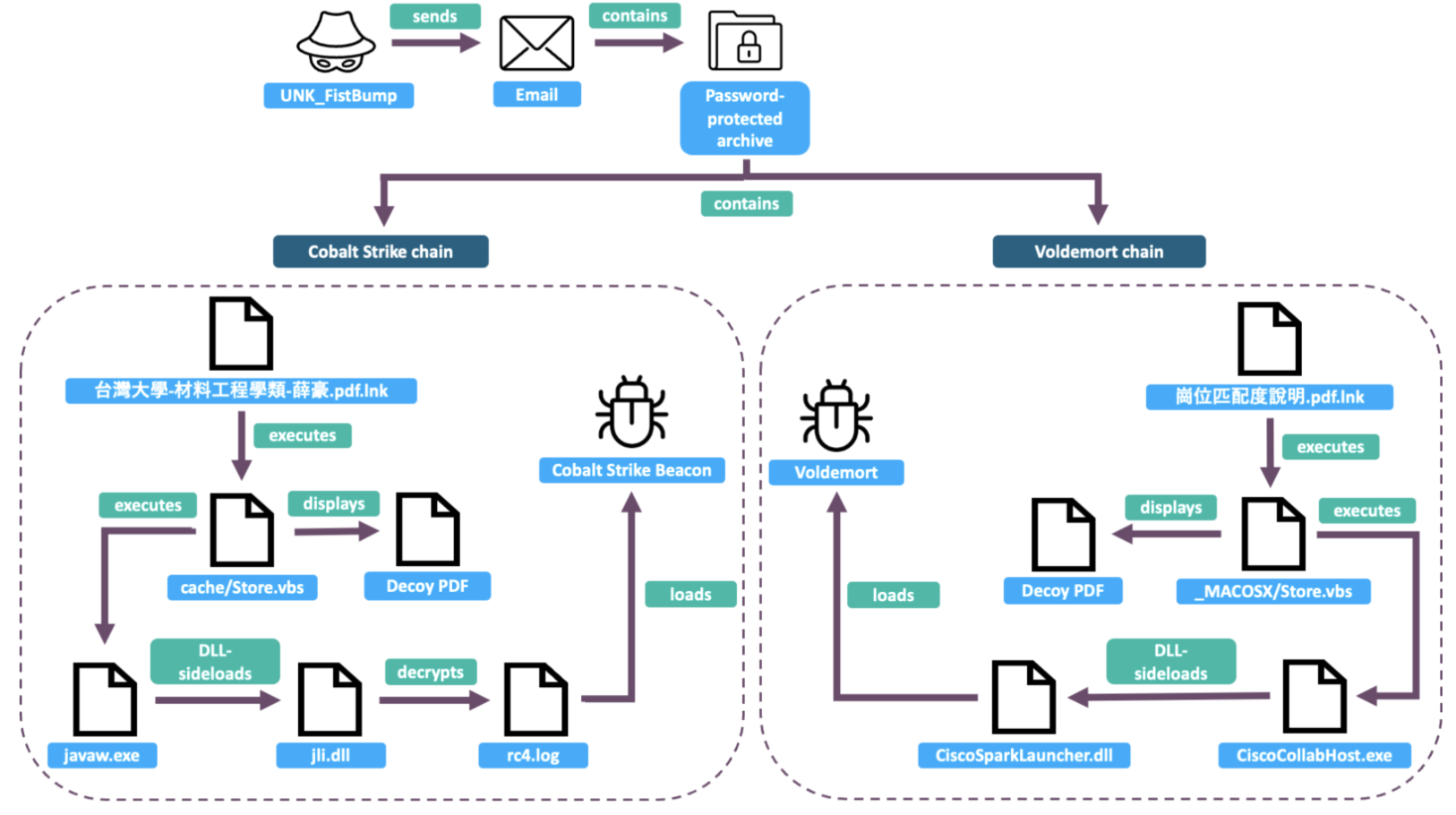
UNK_FistBump RAR archive containing two distinct infection chains.
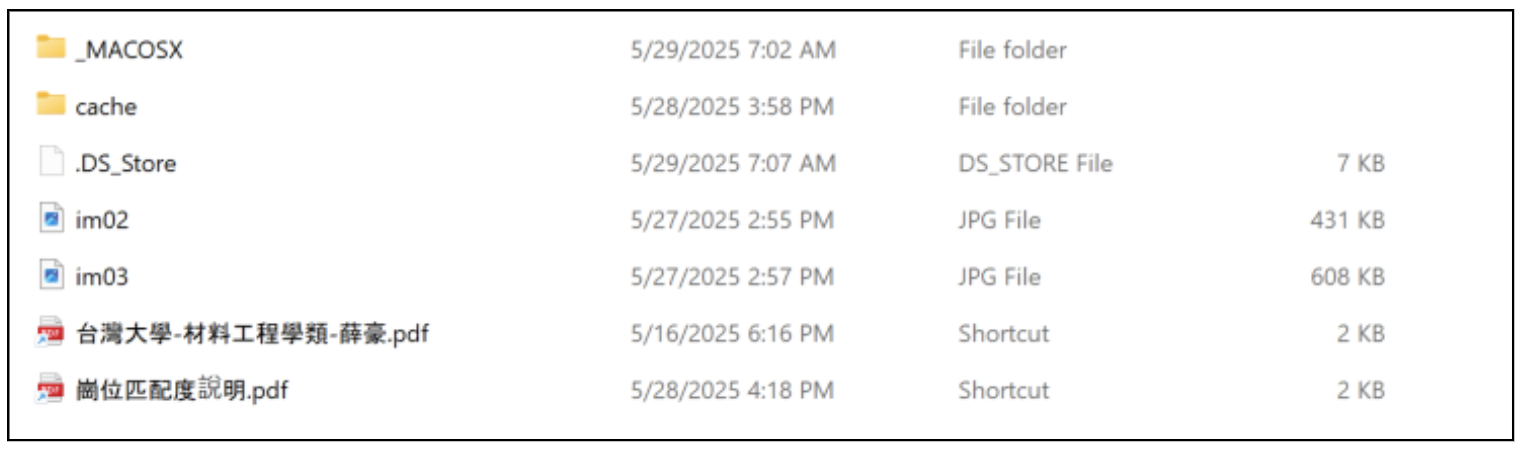
Contents of job application zip containing two distinct infection chains.
Infection chain 1: Cobalt Strike payload
Execution of the first LNK file named 崗位匹配度說明.pdf.lnk runs a VBS script Store.vbs stored within the cache subfolder. This folder contains the following files:
- cache/Store.vbs
- cache/javaw.exe
- cache/崗位匹配度說明.pdf
- cache/rc4.log
- cache/jli.dll
This Store.vbs script copies the files javaw.exe, jli.dll, and rc4.log to the C:\Users\Public\Videos directory and opens a decoy document named 崗位匹配度說明.pdf (machine translation: Explanation of Job Compatibility.pdf). It then executes the benign signed executable javaw.exe, which is vulnerable to DLL-sideloading. This loads the malicious DLL jli.dll, which in turn decrypts the RC4-encrypted Cobalt Strike Beacon payload from the rc4.log file using the key qwxsfvdtv and loads it into memory. The Cobalt Strike Beacon payload uses a customized GoToMeeting malleable C2 profile and communicates with the Evoxt VPS C2 IP address 166.88.61[.]35 over port TCP 443. The jli.dll loader also establishes persistence by setting a HKEY_CURRENT_USER\SOFTWARE\Microsoft\Windows\CurrentVersion\Run key value for runs to the path of the DLL sideloading executable javaw.exe.
Infection chain 2: Voldemort payload
Execution of the second LNK named 台灣大學-材料工程學類-薛豪.pdf.lnk runs another VBS file also called Store.vbs, this time within the MACOSX subfolder. This MACOSX folder contains the following files:
- _MACOSX/Store.vbs
- _MACOSX/台灣大學-材料工程學類-薛豪.pdf
- _MACOSX/CiscoSparkLauncher.dll
- _MACOSX/CiscoCollabHost.exe
- _MACOSX/Cisco.xml
Similar to the Cobalt Strike infection chain, the Store.vbs script copies the malicious executable files to C:\Users\Public\Videos and opens a different decoy document 台灣大學-材料工程學類-薛豪.pdf (Machine translation: National Taiwan University - Materials Engineering - Xue Hao.pdf). It then executes the benign signed executable CiscoCollabHost.exe, which is vulnerable to DLL sideloading and loads the malicious DLL CiscoSparkLauncher.dll. This DLL sideloading chain results in the delivery of the custom Voldemort backdoor, which uses Google Sheets for command and control (C2).

UNK_FistBump resume decoy document.
The specific Voldemort DLL sideloading infection chain and payload observed closely resembles one used by the China state-sponsored threat actor TA415 (APT41, Brass Typhoon), as previously documented by Proofpoint. An earlier Voldemort variation used by UNK_FistBump in May 2025 exfiltrated host information in plain text to the Google Sheets C2, while a later variation Base64-encoded and RC4-encrypted the values using the executable's filename as the RC4 key (CiscoCollabHost.exe) in an identical manner previously highlighted in TA415 activity.
Examining UNK_FistBump and TA415 attribution overlaps
Voldemort is a custom malware family publicly reported by Proofpoint and Google that was historically only used by TA415 within Proofpoint telemetry. Proofpoint Threat Research also previously observed TA415 conducting spearphishing campaigns targeting the Taiwanese semiconductor sector using compromised Taiwanese university senders, in a similar manner to the highlighted UNK_FistBump activity.
However, the observed UNK_FistBump campaigns diverge from activity typically tracked as TA415. For example, the Cobalt Strike infection chain uses a loader not typical of TA415, which usually favors ChaCha20-based loaders rather than the more simplistic RC4 loader used by UNK_FistBump. Similarly, the use of a hardcoded IP address for a C2, rather than a Cloudflare Worker or actor-controlled domain behind Cloudflare CDN, is atypical of TA415 activity. Due to these and other divergences, coupled with the wider propensity of custom capability sharing across Chinese cyberespionage threat actors, Proofpoint is tracking UNK_FistBump activity as distinct to TA415 at this time.
UNK_DropPitch pitches semiconductor investment analysts
In April and May 2025, Proofpoint observed another China-aligned threat actor tracked as UNK_DropPitch conducting targeted phishing campaigns against multiple large investment banks. This activity focused specifically on individuals specializing in financial investment analysis of Taiwanese semiconductor and technology sectors. The phishing emails were sent from attacker-owned email addresses and purported to come from a fictitious financial investment firm seeking to collaborate with the individual.
Delivery
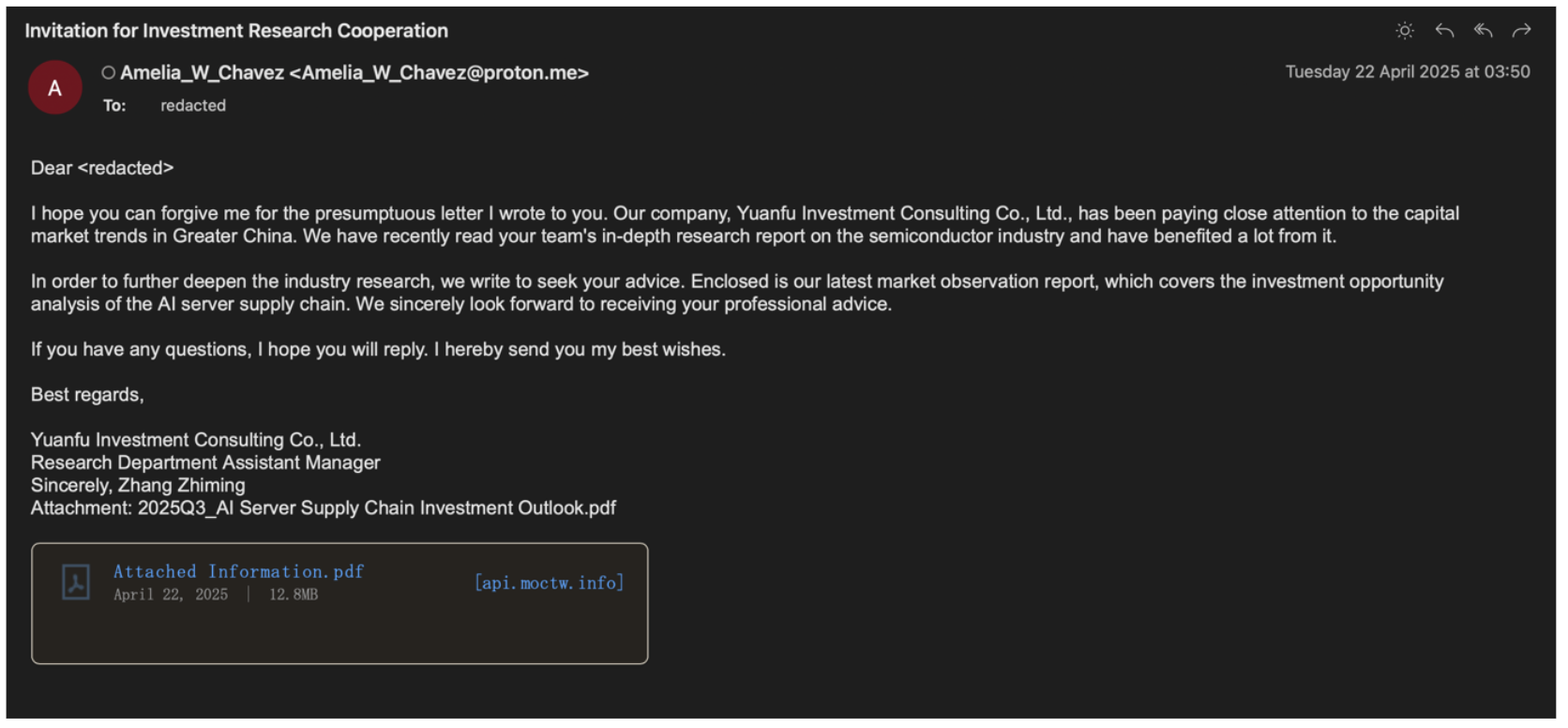
Example UNK_DropPitch investment research collaboration phishing email (machine translated from Traditional Chinese).
In a campaign observed in late April 2025, an UNK_DropPitch phishing email contained a link to hxxps://api[.]moctw[.]info/Intro.pdf. This resulted in the download of a file named Intro.zip containing both a benign executable vulnerable to DLL-sideloading and a malicious DLL libcef.dll, which are designed to load a simple custom backdoor Proofpoint tracks as HealthKick.

UNK_DropPitch Intro.zip contents.
Upon execution, both files are copied to a randomly named subfolder under the ProgramData directory and the following scheduled task named SystemHealthMonitor is created to execute [PDF] Introduction Documents 2 - 250409.exe every five minutes:
schtasks.exe /Create /TN "SystemHealthMonitor" /TR "\"C:\ProgramData\zumArSAB\[PDF] Introduction Documents 2 - 250409.Exe\" -run" /SC MINUTE /MO 5 /F
The HealthKick backdoor then attempts to create a web socket to the actor-controlled IP address 82.118.16[.]72 over TCP port 465. HealthKick employs a FakeTLS protocol and expects a response from the C2 starting with the magic bytes 0x17 0x03 0x03 (the standard header for TLSv1.2), followed by the payload size. Due to the way the malware verifies that incoming packets start with these magic bytes and then later verifies this again, the FakeTLS header needs to be included twice for commands to be properly parsed and decoded, it is unclear if this was an intended feature or a mistake. This double FakeTLS header is then followed by a payload which is XOR encoded with the key mysecretkey.
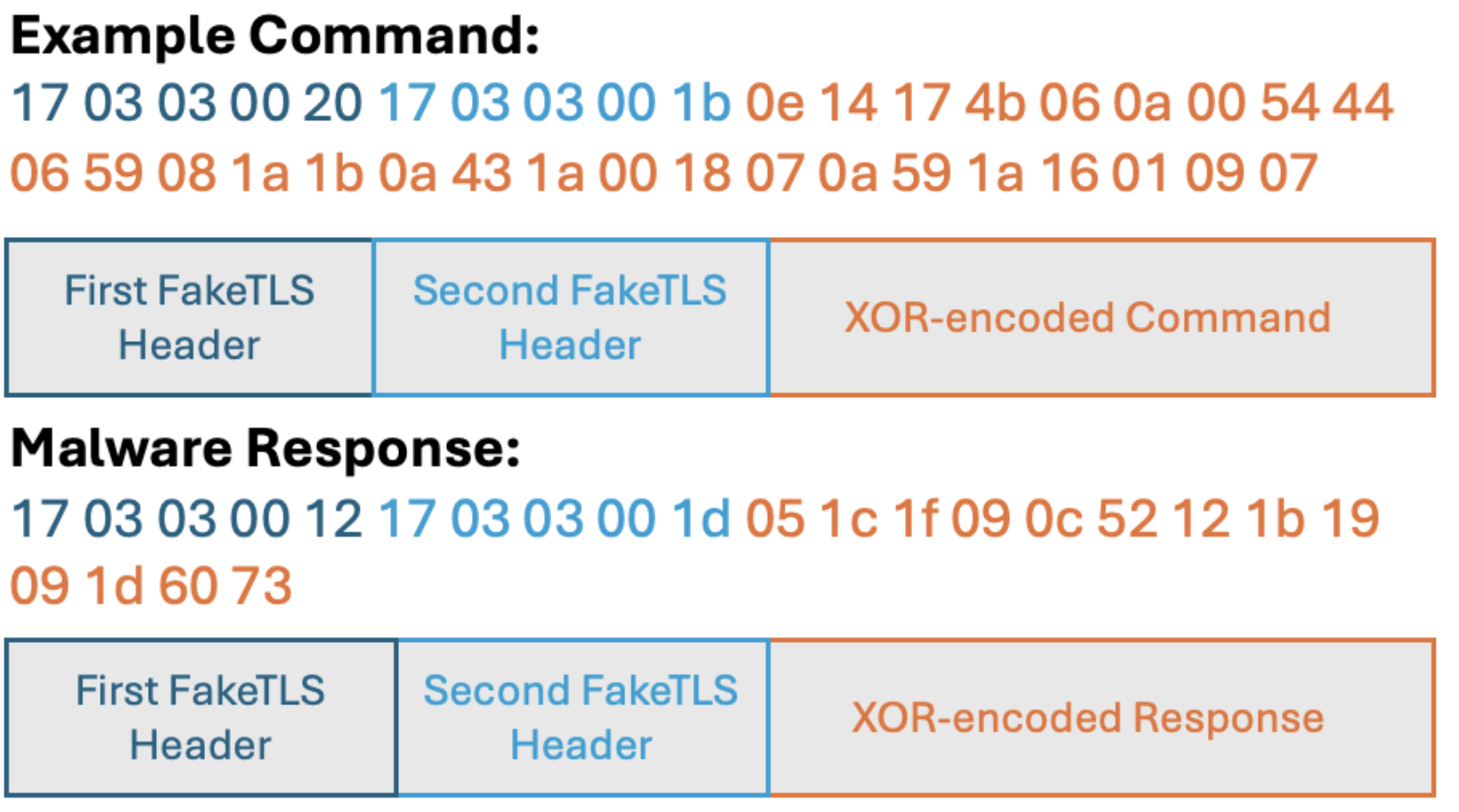
HealthKick TCP socket C2 communication.
HealthKick is a simple backdoor that executes commands and captures their output via a redirected anonymous pipe, which is then sent back to the C2 using the same FakeTLS and XOR-encoded payload format.
A later UNK_DropPitch campaign in late May 2025 linked to the Netlify URL https://brilliant-bubblegum-137cfe[.]netlify[.]app/files/Introduction%20Document.zip
and again delivered a ZIP file containing an executable used to load a malicious DLL named pbvm90.dll. In this case, the resultant malware is a simple raw TCP reverse shell that communicates with the actor-controlled VPS server 45.141.139[.]222 again over TCP port 465 and persists via an identical scheduled task to the one noted above.
This reverse shell features minimal exception or error handling, meaning the server’s response to the malware client connecting (“Server ready”) is interpreted as a command by the implant. Similarly, the reverse shell sends regular “ping” messages to its C2 as a heartbeat. Similar “ping” check ins were also received back from the C2 and often concatenated with the operator’s commands, resulting in errors. Proofpoint also observed typos in the command responses from the operators, indicating the commands are likely issued manually rather than in an automated fashion.
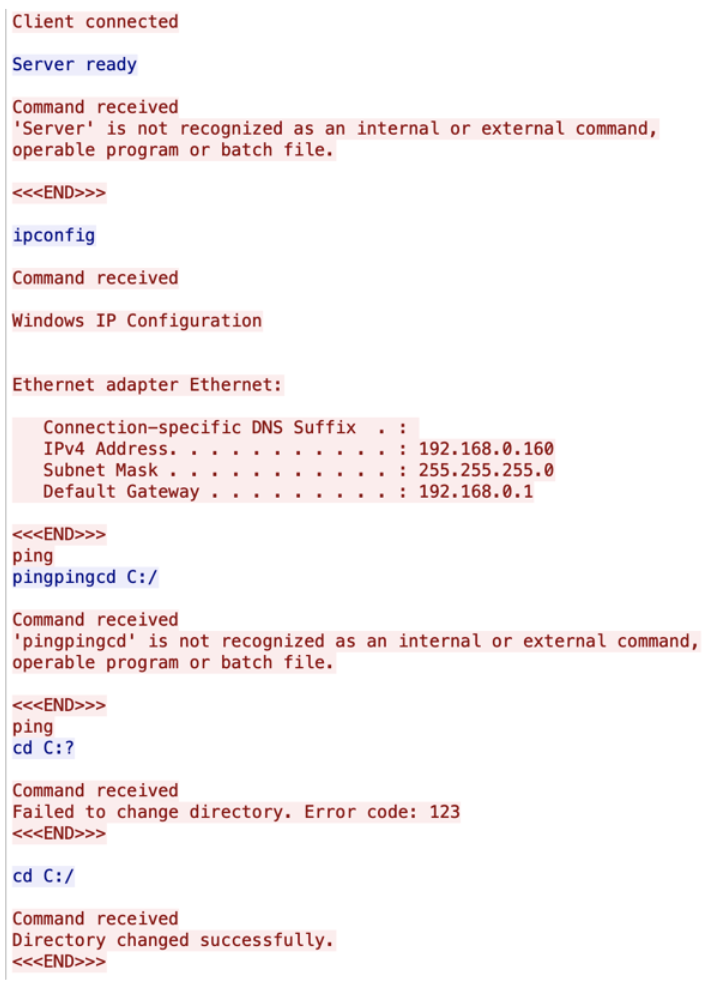
UNK_DropPitch reverse shell errors and typos.
Proofpoint observed UNK_DropPitch using this reverse shell to conduct initial enumeration and discovery against targets. Subsequently, if the target is deemed of interest, the group dropped the Remote Monitoring and Management (RMM) tool Intel Endpoint Management Assistant (EMA), which was configured to communicate with the actor-controlled domain ema.moctw[.]info.
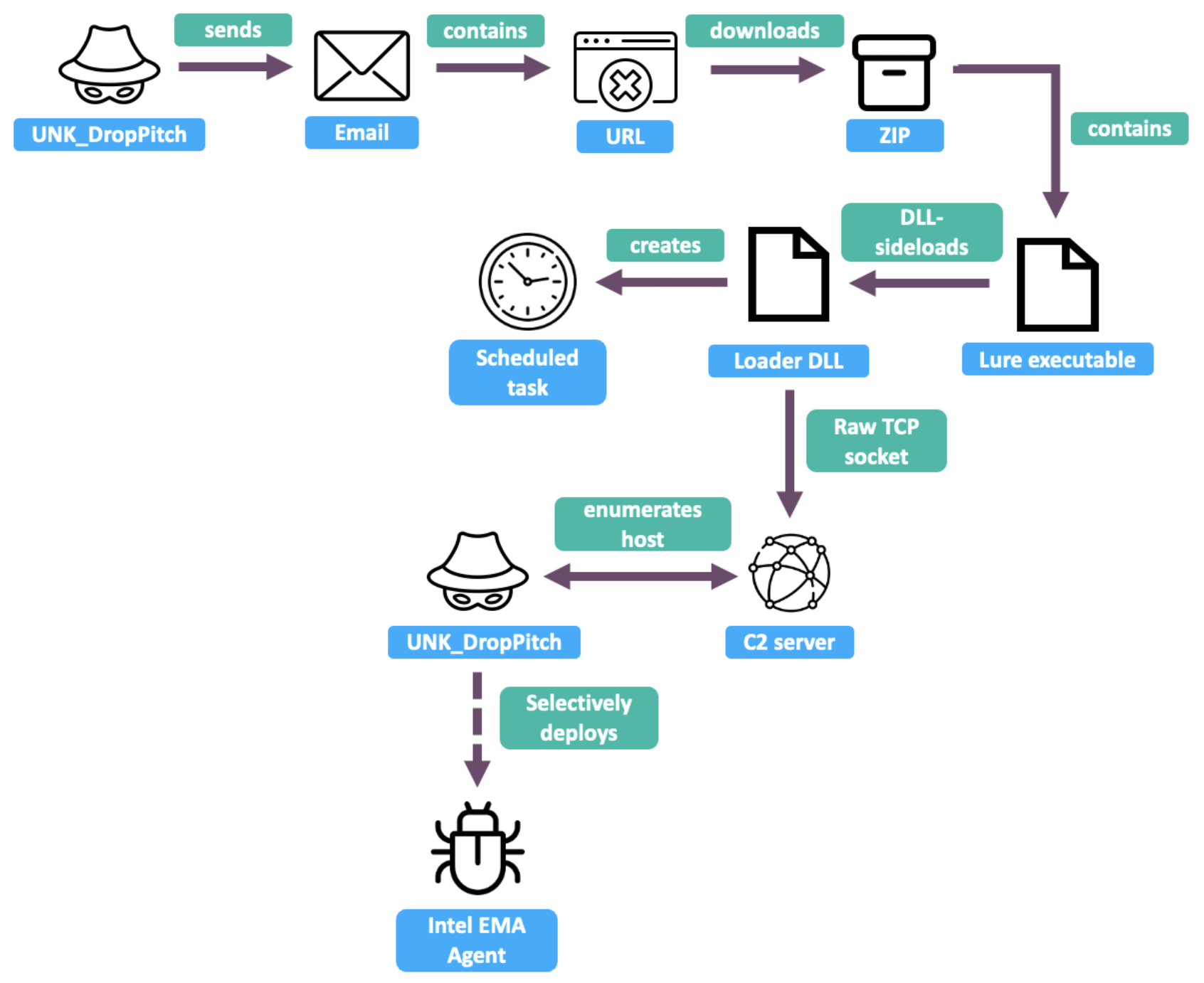
UNK_DropPitch infection chain.
UNK_DropPitch network infrastructure analysis
Both the 82.118.16[.]72 HealthKick backdoor C2 IP address and 80.85.156[.]234 Intel EMA C2 server used very similar reverse DNS names associated with the Russian VPS hosting provider ProfitServer and referenced the Mr. Robot character Elliot Alderson:
- elliot-alderson-971.pserver[.]space
- elliot-alderson-97.pserver[.]space
Multiple similarly named email addresses have also been used by the threat actor. Pivoting on this artifact uncovered additional likely actor-controlled servers, several of which were used as C2 servers in subsequent June 2025 UNK_DropPitch campaigns targeting US academic and think tank organizations:
- 31.192.234[.]97 (elliot-alderson-15.pserver[.]space)
- 80.85.154[.]48 (elliot-alderson-973.pserver[.]space)
- 80.85.154[.]101 (elliot-alderson-151.pserver[.]space)
- 80.85.156[.]237 (elliot-alderson-974.pserver[.]space)
- 80.85.157[.]116 (elliot-alderson-972.pserver[.]space)
- 80.85.157[.]145 (elliot-alderson-978.pserver[.]space)
- 82.118.16[.]72 (elliot-alderson-971.pserver[.]space)
- 82.118.16[.]106 (elliot-alderson-972.pserver[.]space)
Two of these servers were concurrently configured as SoftEther VPN servers, an open-source VPN product commonly used by a range of China-aligned threat actors for both infrastructure administration and tunnelling traffic out of victim networks. The hosting IP address for the UNK_DropPitch subdomain mx.moctw[.]info (43.247.132[.]96) was also configured as a SoftEther VPN server during time of use.
The 80.85.154[.]101 IP address identified above concurrently exhibited a TLS certificate with the common name CN=AS.website (SHA256 fingerprint: 000062e9e212231328b660f759f8878ac47604b9609f71c05ad19d7ef56b17a8) on port TCP 4444. This certificate has been historically associated exhibited on C2 infrastructure associated with multiple custom malware families used by Chinese state-sponsored threat actors, most frequently the SideWalk (aka ScrambleCross) backdoor. The TLS certificate was also noted in Kaspersky reporting on the MoonBounce firmware rootkit and PWC reporting on TA415 (APT41, Brass Typhoon) activity, both in relation to SideWalk usage. At this time, Proofpoint analysts were unable to determine conclusively if the reuse of this TLS certificate is an artifact of a specific custom malware family shared across multiple China-aligned threat actors, most likely SideWalk, or of shared infrastructure provisioning across these groups.
Additional China-aligned threat actors targeting Taiwanese semiconductor industry
In addition to the highlighted UNK_FistBump and UNK_DropPitch activity, Proofpoint has also identified multiple additional Chinese state-sponsored threat actors specifically targeting organizations within Taiwan’s semiconductor industry.
In March 2025, a China-aligned threat actor Proofpoint tracks as UNK_SparkyCarp conducted a credential phishing campaign using a custom adversary-in-the-middle (AITM) framework targeting a Taiwanese semiconductor industry company, which the group also previously targeted in November 2024. The phishing emails masqueraded as account login security warnings and contained a link to the actor-controlled credential phishing domain accshieldportal[.]com, as well as a tracking beacon URL for acesportal[.]com.
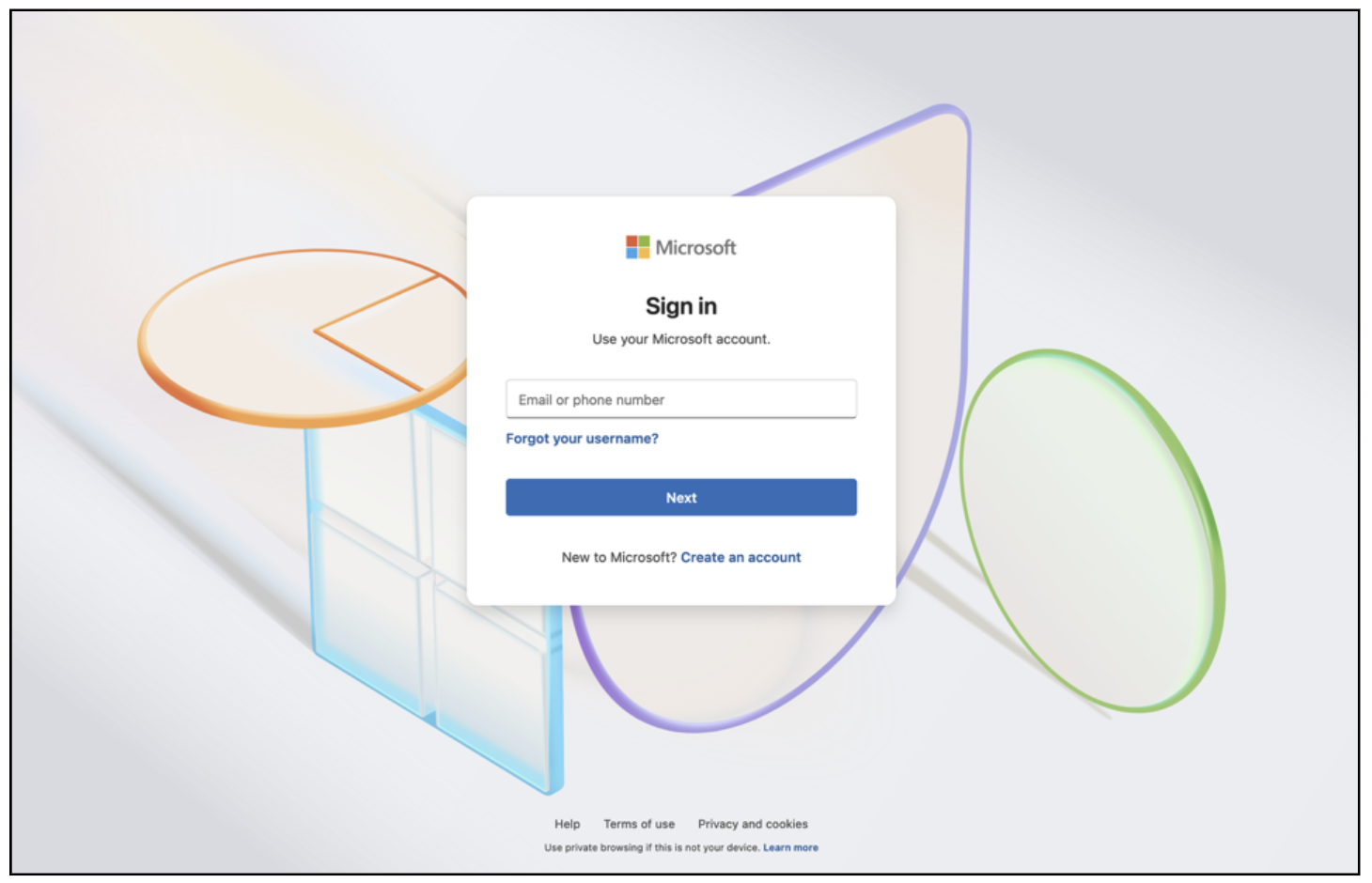
Typical UNK_SparkyCarp AITM phishing kit landing page.
Similarly, in October 2024 Proofpoint observed the China aligned threat actor UNK_ColtCentury (overlaps TAG-100, Storm-2077) sending benign conversation starter emails to legal personnel at a Taiwanese semiconductor organization in an attempt to engage the target. Based on related activity associated with this threat actor, this was likely an attempt to deploy the SparkRAT backdoor.
Conclusion
Within Proofpoint telemetry in recent years, traditional espionage targets – including governments, aerospace and defense companies, and non-governmental organizations – have continued to be consistently targeted by China-aligned espionage threat actors. Despite public reporting on semiconductor targeting from China-aligned threat actors, Proofpoint directly observed only sporadic targeting of this sector. Since March 2025, this shifted to sightings of multiple campaigns from different China-aligned groups specifically targeting this sector, with a particular emphasis on Taiwanese entities.
As many well-established China-aligned threat actors have shifted tactics, techniques and procedures (TTPs) towards exploitation of edge devices and other initial access vectors, Proofpoint has observed an influx of new China-aligned clusters to the phishing threat landscape, as demonstrated by the subset of activity highlighted within this report. These emerging threat actors continue to exhibit long-standing targeting patterns consistent with Chinese state interests, as well as TTPs and custom capabilities historically associated with China-aligned cyberespionage operations.
Indicators of compromise
|
UNK_FistBump Network Indicators |
|||
|
Indicator |
Type |
Description |
First Seen |
|
166.88.61[.]35 |
IP address |
Cobalt Strike C2 |
May 2025 |
|
hxxps://sheets[.]googleapis[.]com:443/v4/spreadsheets/1z8ykHVYh9DF-b_BFDA9c4Q2ojfrgl-fq1v797Y5576Y |
URL |
Voldemort Google Sheets C2 |
May 2025 |
|
hxxps://sheets[.]googleapis[.]com:443/v4/spreadsheets/14H0Gm6xgc2p3gpIB5saDyzSDqpVMKGBKIdkVGh2y1bo |
URL |
Voldemort Google Sheets C2 |
June 2025 |
|
john.doe89e@gmail[.]com |
|
Malware delivery |
May 2025 |
|
hxxps://3008[.]filemail[.]com/api/file/get?filekey=DeHjMusPPgDt5EsWxOcgYCfRh5yI6MIIg7vvwn9yFEzh93Cts5UxrfXMYEPiMWffVCp36UCsVgYSlC47WGdjHZ7m9bAw0QWcgqQZcg&pk_vid=007318ac7ca53d8717482475404ed5a2 |
Delivery |
Filemail staging URL |
May 2025 |
|
UNK_FistBump Malware Indicators |
|||
|
1a2530010ecb11f0ce562c0db0380416a10106e924335258ccbba0071a19c852 |
SHA256 |
協助確認.rar |
June 2025 |
|
084b92365a25e6cd5fc43efe522e5678a2f1e307bf69dd9a61eb37f81f304cc6 |
SHA256 |
台灣大學-材料工程學類-薛豪.rar |
June 2025 |
|
85e4809e80e20d9a532267b22d7f898009e74ed0dbf7093bfa9a8d2d5403f3f9 |
SHA256 |
台灣大學-材料工程學類-薛豪.zip |
May 2025 |
|
338f072cc1e08f1ed094d88aa398472e3f04a8841be2ff70f1c7a2e4476d8ef7 |
SHA256 |
台灣大學-材料工程學類-薛豪.rar |
May 2025 |
|
13fad7c6d0accb9e0211a7b26849cf96c333cf6dfa21b40b65a7582b79110e4b |
SHA256 |
崗位匹配度說明.pdf.lnk |
May 2025 |
|
d783c40c0e15b73b62f28d611f7990793b7e5ba2436e203000a22161e0a00d0e |
SHA256 |
台灣大學-材料工程學類-薛豪.pdf.lnk |
May 2025 |
|
1016ba708fb21385b12183b3430b64df10a8a1af8355b27dd523d99ca878ffbb |
SHA256 |
台灣大學-材料工程學類-薛豪.pdf.lnk |
May 2025 |
|
13fad7c6d0accb9e0211a7b26849cf96c333cf6dfa21b40b65a7582b79110e4b |
SHA256 |
Bumping工程師-台灣大學-材料工程學類-薛豪.pdf.lnk
台灣大學-材料工程學類-薛豪.pdf.lnk |
May 2025 |
|
1016ba708fb21385b12183b3430b64df10a8a1af8355b27dd523d99ca878ffbb |
SHA256 |
2025年度薪資調整辦法公告.pdf.lnk |
June 2025 |
|
bab8618bc6fc3fdfa7870b5fe0f52b570fabf0243d066f410a7e76ebeed0088c |
SHA256 |
Store.vbs |
May 2025 |
|
0d992762c69d624a1f14a8a230f8a7d36d190b49e787fd146e9010e943c5ef78 |
SHA256 |
Store.vbs |
May 2025 |
|
ec5fef700d1ed06285af1f2d01fa3db5ea924de3c2da2f0e6b7a534f69d8409c |
SHA256 |
Store.vbs |
June 2025 |
|
82ecfe0ada6f7c0cea78bca2e8234241f1a1b8670b5b970df5e2ee255c3a56ef |
SHA256 |
CiscoSparkLauncher.dll (Voldemort loader DLL) |
May 2025 |
|
cd009ea4c682b61963210cee16ed663eee20c91dd56483d456e03726e09c89a7 |
SHA256 |
CiscoSparkLauncher.dll (Voldemort loader DLL) |
June 2025 |
|
bbdad59db64c48f0a9eb3e8f2600314b0e3ebd200e72fa96bf5a84dd29d64ac5 |
SHA256 |
jli.dll (Cobalt Strike loader DLL) |
May 2025 |
|
fc8f7185a90af4bf44332e85872aa7c190949e3ec70055a38af57690b6604e3c |
SHA256 |
rc4.log (Cobalt Strike Beacon encrypted payload) |
May 2025 |
|
UNK_DropPitch Network Indicators |
|||
|
Indicator |
Type |
Description |
First Seen |
|
amelia_w_chavez@proton[.]me |
|
Malware delivery |
April 2025 |
|
lisan_0818@outlook[.]com |
|
Malware delivery |
May 2025 |
|
moctw[.]info |
Domain |
Malware delivery |
April 2025 |
|
hxxps://api[.]moctw[.]info/Intro.pdf |
URL |
Malware delivery |
April 2025 |
|
hxxps://api[.]moctw[.]info/Document-2025.4.25.pdf |
URL |
Malware delivery |
April 2025 |
|
hxxps://api[.]moctw[.]info/Install.zip |
URL |
Malware delivery |
April 2025 |
|
hxxps://brilliant-bubblegum-137cfe[.]netlify[.]app/files/Introduction%20Document.zip |
URL |
Malware delivery |
May 2025 |
|
ema.moctw[.]info |
Domain |
C2 |
April 2025 |
|
www.twmoc[.]info |
Domain |
C2 |
June 2025 |
|
80.85.156[.]234 |
IP Address |
C2 |
April 2025 |
|
82.118.16[.]72 |
IP Address |
C2 |
April 2025 |
|
45.141.139[.]222 |
IP Address |
C2 |
May 2025 |
|
80.85.156[.]237 |
IP Address |
C2 |
June 2025 |
|
80.85.154[.]48 |
IP Address |
C2 |
June 2025 |
|
UNK_DropPitch Malware Indicators |
|||
|
7bffd21315e324ef7d6c4401d1bf955817370b65ae57736b20ced2c5c08b9814 |
SHA256 |
Intro.zip |
April 2025 |
|
9b2cbcf2e0124d79130c4049f7b502246510ab681a3a84224b78613ef322bc79 |
SHA256 |
libcef.dll |
April 2025 |
|
4ee77f1261bb3ad1d9d7114474a8809929f4a0e7f9672b19048e1b6ac7acb15c |
SHA256 |
libcef.dll |
April 2025 |
|
d3a71c6b7f4be856e0cd66b7c67ca0c8eef250bc737a648032d9d67c2c37d911 |
SHA256 |
[PDF] Introduction Document-2025.4.25.lnk |
April 2025 |
|
366d7de8a941daa6a303dc3e39af60b2ffacaa61d5c1fb84dd1595a636439737 |
SHA256 |
Introduction Document.zip |
May 2025 |
|
d51c195b698c411353b10d5b1795cbc06040b663318e220a2d121727c0bb4e43 |
SHA256 |
[PDF]Taiwan-Cooperation-Introduction-Document-20250521.exe |
May 2025 |
|
ffd69146c5b02305ac74c514cab28d5211a473a6c28d7366732fdc4797425288 |
SHA256 |
pbvm90.dll |
May 2025 |
|
UNK_SparkyCarp Network Indicators |
|||
|
accshieldportal[.]com |
Domain |
UNK_SparkyCarp credential phishing domain |
March 2025 |
|
acesportal[.]com |
Domain |
Tracking pixel domain |
March 2025 |
|
hxxps://ttot.accshieldportal[.]com/v3/ls/click/?c=b5c64761 |
URL |
Credential phishing URL |
March 2025 |
|
hxxps://aqrm.accshieldportal[.]com/v2/account/validate/?vid=35f46f46 |
URL |
Credential phishing URL |
March 2025 |
|
hxxps://acesportal[.]com/T/bfzWhb |
URL |
Tracking pixel URL |
March 2025 |
|
hxxps://acesportal[.]com/T/KRfzAH |
URL |
Tracking pixel URL |
March 2025 |
|
menglunwuluegg226@proton[.]me |
|
Malware delivery |
March 2025 |
|
lonelyboymaoxcz231@proton[.]me |
|
Malware delivery |
March 2025 |
ET rules
2063450 - ET HUNTING GoogleSheets API V4 Activity (Fetch Single Cell with A1 Notation)
2063451 - ET HUNTING GoogleSheets API V4 Response (Single Cell with UUID)
2063452 - ET HUNTING GoogleSheets API V4 Activity (Possible Exfil)
2063453 - ET MALWARE Voldemort System Info Exfil
2063454 - ET PHISHING Observed DNS Query to UNK_SparkyCarp Domain
2063455 - ET PHISHING Observed DNS Query to UNK_SparkyCarp Domain
2063456 - ET PHISHING Observed UNK_SparkyCarp Domain in TLS SNI
2063457 - ET MALWARE Observed DNS Query to UNK_DropPitch Domain
2063458 - ET MALWARE Observed UNK_DropPitch Domain in TLS SNI
2063459 - ET PHISHING Observed UNK_SparkyCarp Domain in TLS SNI
2063460 - ET MALWARE Observed DNS Query to UNK_DropPitch Domain
2063461 - ET MALWARE Observed UNK_DropPitch Domain in TLS SNI