
Most Due Diligence Focuses on Assets. Insider Risk Often Doesn't.
When organizations evaluate an acquisition, they perform extensive diligence around financial performance, intellectual property, regulatory obligations, contracts, cybersecurity controls, and operational risks.
These efforts help buyers understand what they are acquiring and how much risk they are assuming.
But there is one category of risk that is often much harder to assess:
Human behavior.
Mergers and acquisitions create periods of significant organizational change. Employees gain access to new information, teams are restructured, reporting lines shift, and uncertainty increases. Sensitive information moves across legal, financial, operational, and technical workstreams. At the same time, organizations are often operating under aggressive timelines that prioritize business outcomes over comprehensive visibility.
The result is a form of risk many organizations underestimate: insider-risk exposure that may emerge before, during, or after a transaction and only become visible after significant business value is already at stake.
Unlike many operational or financial risks, insider-risk exposure does not necessarily remain within one organization. It can move with employees, data, access, and business processes as companies merge.
Recent acquisition-era disputes illustrate why organizations should think about insider risk as a strategic business concern rather than solely a security issue.
When Insider Risk Becomes Part of the Transaction
Mergers, acquisitions, divestitures, and other organizational changes create periods of heightened insider risk. As sensitive information is shared across teams, business units, and external stakeholders, organizations face increased exposure to data loss, unauthorized disclosures, and policy violations.
These risks are rarely the result of a single malicious act. More often, they emerge from expanded access, shifting responsibilities, increased collaboration, and the pressure to move quickly while maintaining confidentiality. Security teams must balance enabling the transaction with protecting critical data.
The Insider Threat MatrixTM provides a framework for understanding how insider risk can develop and escalate throughout the transaction lifecycle. By mapping activity across the matrix's five phases, organizations can identify early warning signs, distinguish legitimate business activity from risky behavior, and intervene before isolated events become significant incidents.
Yet many transaction-related risks remain hidden. Changes in access patterns, employee behavior, and sensitive data movement can quietly accumulate over time, creating hidden insider-risk debt that may not become apparent until long after the transaction is complete.
Hidden Insider-Risk Debt
Organizations frequently talk about inheriting technical debt through acquisitions.
The same concept can apply to insider risk.
Excessive permissions, poorly governed repositories, unmanaged collaboration environments, contractor access, unresolved investigations, and risky user behaviors can all exist long before a deal is announced.
Yet these issues rarely appear neatly categorized in diligence reports.
Instead, they frequently remain hidden until integrated systems, shared data, employee departures, or internal investigations expose them.
Just as technical debt can create future operational costs, insider-risk debt can create future legal, regulatory, operational, and reputational consequences.
The challenge is not simply identifying whether risk exists.
The challenge is identifying whether risk is already developing.
Traditional due diligence excels at evaluating tangible business assets. Assessing developing insider-risk exposure is often more difficult.
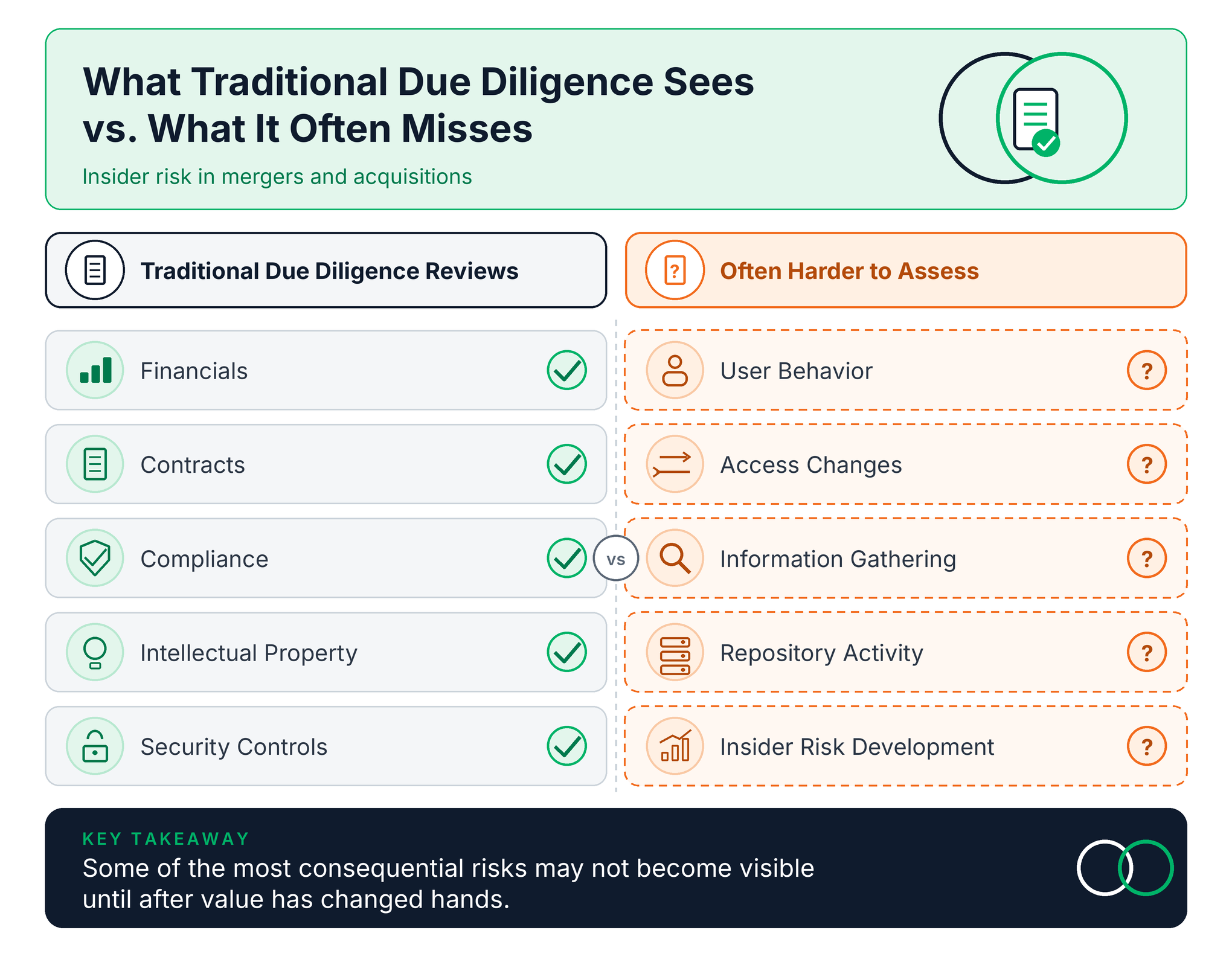
Figure 1. Traditional due diligence provides strong visibility into business assets and controls, but developing insider-risk exposure is often more difficult to assess.
Why M&A Creates a Unique Insider-Risk Window
Acquisitions bring together several conditions that rarely occur simultaneously.
Change Creates Uncertainty
Employees often face unanswered questions about future roles, compensation, reporting structures, and organizational priorities.
Most employees navigate these transitions professionally. However, periods of uncertainty can influence behavior in ways that would not occur under normal circumstances.
Access Changes Faster Than Oversight
As organizations prepare for integration, employees may gain access to systems, repositories, collaboration platforms, and confidential information outside their traditional responsibilities.
This expansion of access is frequently necessary for operational reasons.
It can also create new risk.
Data and People Move Simultaneously
Employees join new teams.
Contractors gain access.
Systems are integrated.
Repositories are consolidated.
M&A activity creates an environment where both people and data are moving at the same time, making it more difficult to distinguish expected activity from emerging risk.
Time Compression Amplifies Risk
Major transactions operate under tight deadlines.
Responsibilities change rapidly.
Access changes rapidly.
Information moves rapidly.
Behavior that might develop gradually in a stable environment can emerge in weeks or even days during a transaction.
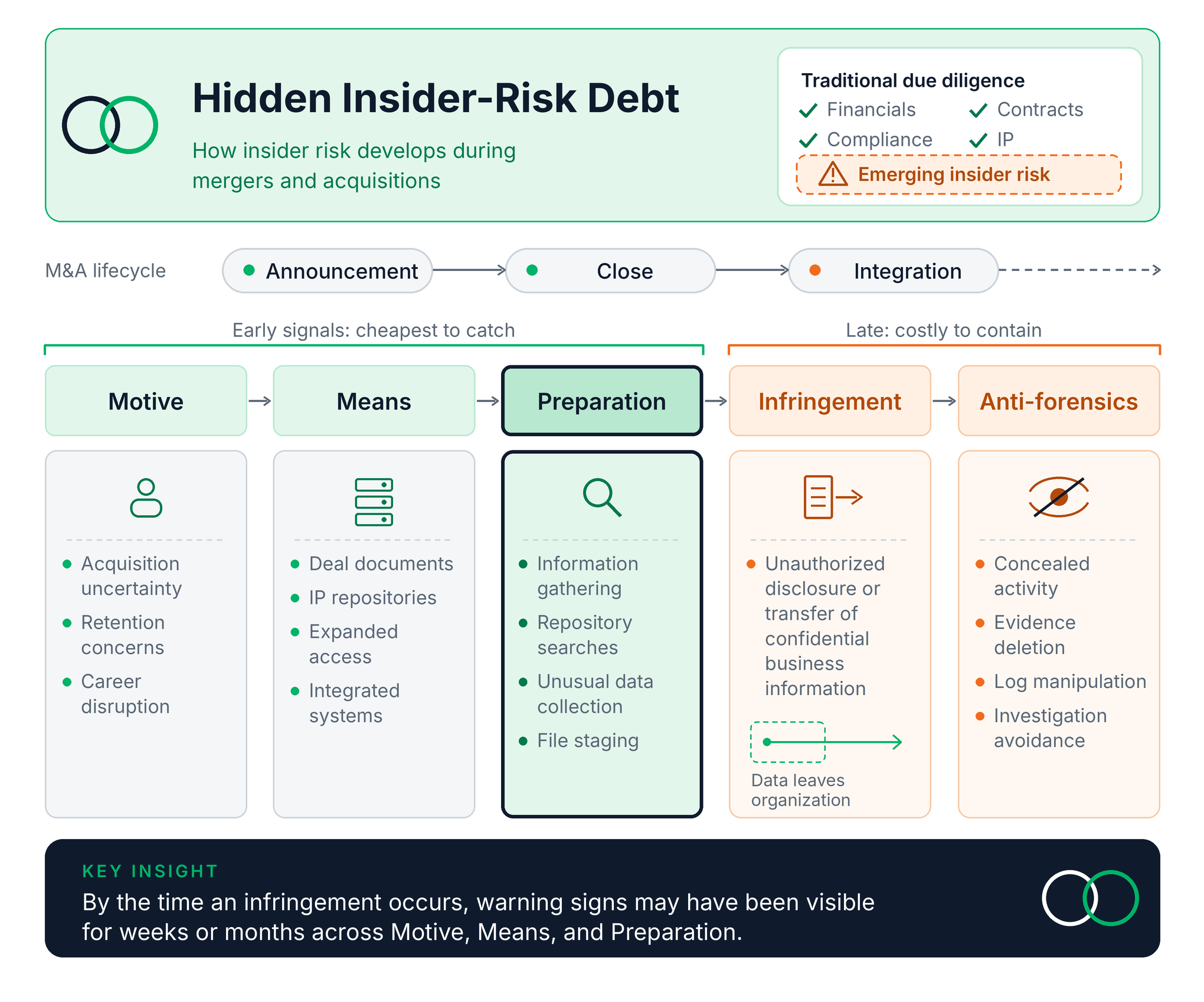
Figure 2. M&A-related insider risk often develops across the Motive, Means, and Preparation phases before an infringement occurs.
Insider Risk Is a Progression, Not an Event
Organizations often focus on the moment confidential information is disclosed, retained, transferred, or misused.
Unfortunately, that is often the point where response options become most limited.
Most insider incidents develop through a sequence of observable behaviors that align to the Insider Threat MatrixTM.
| Insider Threat MatrixTM Phase | M&A Example |
|---|---|
| Motive | Career uncertainty, financial incentives, retention concerns, competitive opportunities, or other factors associated with organizational change |
| Means | Access to deal materials, intellectual property, sensitive repositories, collaboration platforms, and newly integrated systems |
| Preparation | Broad repository access, unusual information gathering, expanded collaboration activity, file staging, or collection of sensitive information |
| Infringement | Unauthorized retention, disclosure, transfer, or use of confidential business information |
| Anti-Forensics | Actions intended to conceal activity, remove evidence, obscure transfers, or frustrate a subsequent investigation |
No single activity proves malicious intent.
Many of these actions may have legitimate business explanations when viewed individually.
The value of insider-risk programs comes from understanding how activity evolves over time and how individual events connect into a broader narrative.
Organizations that identify indicators during the Motive, Means, and Preparation phases generally have more opportunities to intervene before an infringement occurs.
What Mature Organizations Do Differently
The most effective insider-risk programs approach acquisitions differently.
Rather than focusing exclusively on policy violations or exfiltration events, they focus on four foundational capabilities.
Visibility
They monitor how user behavior changes during periods of organizational transition.
Context
They evaluate activity based on role, responsibility, access, and business need.
Prioritization
They connect related activities into meaningful narratives rather than treating events as isolated alerts.
Response
They apply appropriate interventions based on evolving risk and business context.
Closing the Visibility Gap
The common challenge running through acquisition-related insider-risk scenarios is visibility.
Organizations cannot investigate activity they cannot see.
They cannot connect events that remain isolated.
And they cannot identify emerging risk if the only signal arrives after information has already been compromised.
Effective insider-risk programs provide visibility across endpoints, cloud applications, collaboration platforms, email, repositories, and emerging AI workflows. They combine behavioral signals, data movement, business context, and investigative workflows into a more complete understanding of risk.
Rather than focusing exclusively on the final infringement, mature programs seek to identify indicators earlier across the Motive, Means, and Preparation phases.
How Proofpoint® Helps
Proofpoint's Insider Risk solution is designed around these objectives.
It helps organizations identify behavioral changes earlier, correlate related activity into meaningful investigations, provide investigators with business context, and support proportionate responses as risk evolves.
The goal is not to determine the outcome of a transaction or replace due diligence processes.
The goal is to help organizations understand how people and data behave during periods of significant organizational change.
The Takeaway
The most consequential insider-risk events associated with mergers and acquisitions rarely begin with the infringement itself.
More often, they emerge through a series of signals across the Motive, Means, and Preparation phases that remain difficult to see when viewed in isolation.
Organizations that can identify those signals earlier, understand behavior in context, connect activity into meaningful narratives, and investigate effectively are better positioned to protect intellectual property, preserve transaction value, and reduce business risk.
Because when it comes to insider risk during M&A, the greatest challenge is often not what organizations know.
It's what they cannot yet see.
What's Next in This Series
This article is the first in a three-part series examining common insider-risk scenarios through the lens of the Insider Threat MatrixTM.
In the coming weeks, we'll explore two additional scenarios that demonstrate how insider risk can emerge in very different contexts:
- Departing Employees: Why the most important warning signs often appear before an employee gives notice.
- Fraudulent Workers: How legitimate access can conceal illegitimate intent, and why some insider risks may exist before employment even begins.
While the circumstances differ, each scenario demonstrates how insider risk often progresses through the same five phases: Motive, Means, Preparation, Infringement, and Anti-Forensics.
Understanding those phases helps organizations move beyond reacting to incidents and toward identifying risk earlier in its lifecycle.
Next up: Why does resignation often reveal risk that may have been developing long before an employee decided to leave?
Learn More About the Insider Threat MatrixTM
Proofpoint is proud to sponsor the Insider Threat MatrixTM, helping organizations establish a common framework for understanding and mitigating insider risk.
Learn how the Insider Threat MatrixTM helps security teams identify indicators across Motive, Means, Preparation, Infringement, and Anti-Forensics, and why Proofpoint supports the initiative.
Learn More About the Insider Threat MatrixTM
Insider Threat Matrix™ is owned by Forscie Limited. Insider Threat Matrix is a trademark of Forscie Limited.