
If you're modernizing email infrastructure on AWS, you face a common challenge: how do you give developers the speed they need while maintaining the security controls your compliance team requires? This post shows you how to combine Amazon Simple Email Service (Amazon SES), a cloud-based email service provider, with Proofpoint Secure Email Relay (SER) to send application email at scale while keeping centralized policy enforcement, domain protection, and compliance controls in place. You'll learn the architecture, understand when this approach makes sense, and get a practical rollout model to follow.
Cloud email has become business-critical infrastructure
Application email was once a narrow operational function used for password resets, invoices, alerts, and status updates. Today, it is a customer communication channel, a security concern, and a business-critical dependency. As organizations modernize on Amazon Web Services (AWS), more email originates from cloud applications, software-as-a-service (SaaS) platforms, workflow systems, AI-enabled tools, and third-party services.
Amazon SES gives teams a cloud-native way to send high-volume transactional, marketing, and notification emails from applications. Amazon SES is a cost-effective email service built on the reliable and scalable infrastructure with API, SMTP, and console-based sending options. This makes it an attractive choice for developers and cloud teams seeking speed, elasticity, and operational efficiency without maintaining traditional email infrastructure.
Email modernization also changes the control model. As outbound application email expands beyond a handful of on-premises relays into multiple cloud workloads and SaaS senders, Proofpoint SER complements Amazon SES providing central messaging and security teams visibility and systematic policy enforcement.
The benefits of AWS and Amazon SES
AWS provides the foundation for modernization through elastic infrastructure, managed services, security tooling, and a pay-as-you-go operating model. For email, Amazon SES extends that model to both outbound and inbound email workloads.
Teams can integrate email directly into applications through SMTP or APIs, automate transactional communications, and support marketing and notification use cases globally.
|
Benefit |
Why it matters to Customers |
|
Scalable sending |
Amazon SES is designed for high-volume email automation, allowing applications to send transactional, marketing, and notification messages without requiring teams to operate mail servers. |
|
Flexible integration |
Developers can send through the Amazon SES console, SMTP interface, AWS CLI, or AWS SDKs, making the service adaptable to both new and existing application architectures. |
|
Cost efficiency |
Pay-as-you-go pricing helps align email spend with actual usage rather than fixed infrastructure costs. |
|
Deliverability support |
Amazon SES provides deliverability tools, sender statistics, reputation monitoring, and Virtual Deliverability Manager capabilities to help teams improve sending performance. |
Amazon SES also integrates naturally with broader AWS services. Applications can trigger email from compute services, such as AWS Lamda, use AWS Identity and Access Management (IAM), and align sending with cloud-native monitoring and operational practices. Your product, engineering, and growth teams can deliver customer communications faster with fewer infrastructure burdens.
Where cloud email modernization gets complicated
The same flexibility that makes application email easier to deploy can make it more difficult to govern. In many enterprises, email now originates from internal applications, SaaS tools, printers, workflow engines, customer platforms, and third-party senders. Without a standardized architecture, each sender can become its own exception path.
Common challenges include:
- Decentralized control: Messaging and security teams may no longer have a central point for governing outbound email.
- Brand and domain risk: Compromised or poorly governed senders can misuse trusted domains, damaging brand reputation and increasing fraud risk.
- Authentication complexity: SPF, DKIM, and DMARC alignment become more difficult as the number of senders and third-party platforms grows.
- Sensitive data exposure: Application email may contain personally identifiable information (PII), protected health information (PHI), invoices, statements, or account details that require data loss prevention (DLP), encryption, and audit controls.
- Deliverability and reputation fragmentation: User and application email can affect one another if they are not segmented and managed separately.
- Limited visibility: Troubleshooting becomes more difficult when sending data, policy decisions, and security events are distributed across multiple systems.
AWS and Proofpoint both describe this shift as a modernization challenge. Traditional on-premises SMTP relays provided a straightforward control point, but cloud migration and outsourced sending make centralized governance more difficult. The goal is not to slow developers down. It is to provide a simple sending path while restoring the governance model that messaging and security teams require.
How Amazon SES and SER work together
A common approach is to use Amazon SES as the scalable sending foundation and Proofpoint Secure Email Relay (SER) as the security and governance layer for application-generated email.
Mail Manager, a feature of Amazon SES, strengthens email infrastructure, simplifies email workflow management, and streamlines email compliance control. It can apply traffic policies and rule sets, then use SMTP relay actions to route email to external infrastructure such as third-party gateways.
In this design, applications send through SES. Mail Manager conditionally routes relevant outbound email to SER. SER then validates approved sources, scans for malicious content, applies centrally managed policies, supports DLP and encryption where required, performs DKIM signing, and helps align application email with DMARC requirements.
Amazon SES acts as the cloud-native sending engine. SES Mail Manager routes policy-relevant traffic to Proofpoint SER, which applies centralized security, authentication, and governance before delivery.
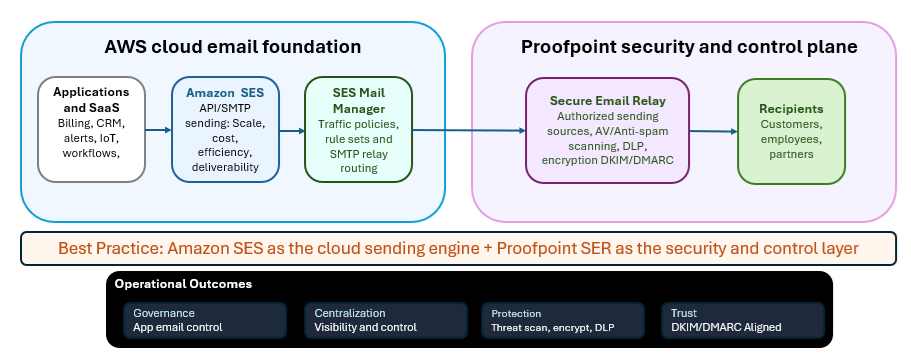
Fig. 1) Workflow of Amazon SES Mail Manager and Proofpoint Secure Email Relay
What SER adds to the Amazon SES foundation
Proofpoint SER is designed for application and transactional email sent by internal applications, devices, SaaS platforms, and third-party partners. Proofpoint describes SER as a cloud-based solution that centralizes management for applications and partners sending from organizational domains.
|
Challenge |
SER capability |
Business outcome |
|
Too many senders |
Authorizes and centralizes application, device, and third-party sending sources |
Fewer shadow IT paths and a clearer operating model |
|
Domain misuse risk |
Blocks or disables compromised third-party senders and enforces trusted relay use |
Better protection for brand identity and customers |
|
Authentication gaps |
Applies DKIM signing and supports DMARC-aligned sending |
Stronger email trust and faster DMARC adoption |
|
Sensitive data exposure |
Applies optional encryption, DLP, and archiving controls |
Reduced regulatory and data-loss risk |
|
Threats in application email |
Scans outbound email with antispam and antivirus controls |
Reduced risk from machine-generated traffic |
|
Limited insight |
Provides reporting for application email sources and volumes |
Faster investigation and sender-level accountability |
Why Amazon SES and SER work better together
If you are modernizing on AWS, consider standardizing outbound application email on a combined Amazon SES and SER architecture. Amazon SES serves as the developer-friendly, cloud-native sending layer, while SER provides centralized policy enforcement, sender governance, threat scanning, DLP, encryption, DKIM signing, and DMARC alignment.
This approach is particularly valuable for enterprise, regulated, or brand-sensitive environments where application email carries business-critical communications or customer data. It enables product and engineering teams to move quickly while giving messaging and security teams the governance controls they need.
Recommendation: Use Amazon SES as the cloud-native sending foundation and SER as the security, policy, and trusted-domain enforcement layer for application-generated email.
A practical rollout model
- Inventory all senders. Identify internal applications, SaaS platforms, devices, batch jobs, and third-party partners that send email using company domains.
- Separate application email from user email. Maintain distinct ownership, reporting, and reputation strategies.
- Establish domain authentication. Configure Amazon SES identities and implement SPF, DKIM, and DMARC controls appropriate to each domain and subdomain.
- Route through Mail Manager. Use traffic policies and rule sets to route application-generated email to SER through SMTP relay.
- Centralize SER policy. Approve sending sources, apply malware and spam scanning, define DLP and encryption rules, and enable DKIM signing.
- Operationalize governance. Create a shared operating model across application owners, cloud teams, messaging teams, security teams, and business stakeholders.
The business value
The Amazon SES and SER model transforms outbound application email from a collection of point integrations into a governed service. Developers retain a simple way to send email from cloud applications. Security teams gain policy control. Messaging teams gain a clearer relay architecture. Business owners gain greater confidence in communications with customers, partners, and employees.
This approach helps you modernize, while maintaining customer trust. Email remains one of the most visible expressions of a brand. When organizations scale application email through SES and secure it through SER, transactional messages become easier to govern, authenticate, monitor, and protect.
Call to action
Amazon SES provides a strong cloud-native foundation for integrating email into modern application environments. Proofpoint Secure Email Relay (SER) strengthens that foundation by adding the centralized governance, security controls, and visibility enterprises need as email sending becomes more distributed.
Together, Amazon SES and Proofpoint SER enable a modern email architecture that balances developer agility with enterprise-grade security, governance, brand protection, and regulatory compliance.
To learn how Amazon SES and Proofpoint Secure Email Relay can help simplify onboarding while strengthening security and compliance, view our webinar on this topic or contact your Proofpoint representative to schedule time to discuss your specific needs.