

Generative AI Data Security

Generative AI Data Security for Enterprise AI Applications

Protect sensitive data across sanctioned and shadow AI applications with unified AI data governance, visibility, and controls for secure enterprise AI adoption.

Abstract metallic forms representing generative AI and data security technology.
Business professionals collaborating around a table during an office meeting.

Secure AI Adoption

Adopt AI safely without sacrificing productivity

To make enterprise data AI-ready and adopt generative AI safely, organizations need more than AI usage monitoring. They need to understand where sensitive data lives, who or what can access it, and how users, copilots, and AI agents interact with it. Generative AI data security reduces the risk of data exposure while governing sensitive data use across approved and shadow AI tools, AI training pipelines, and retrieval-augmented generation (RAG) workflows.
Become AI-ready

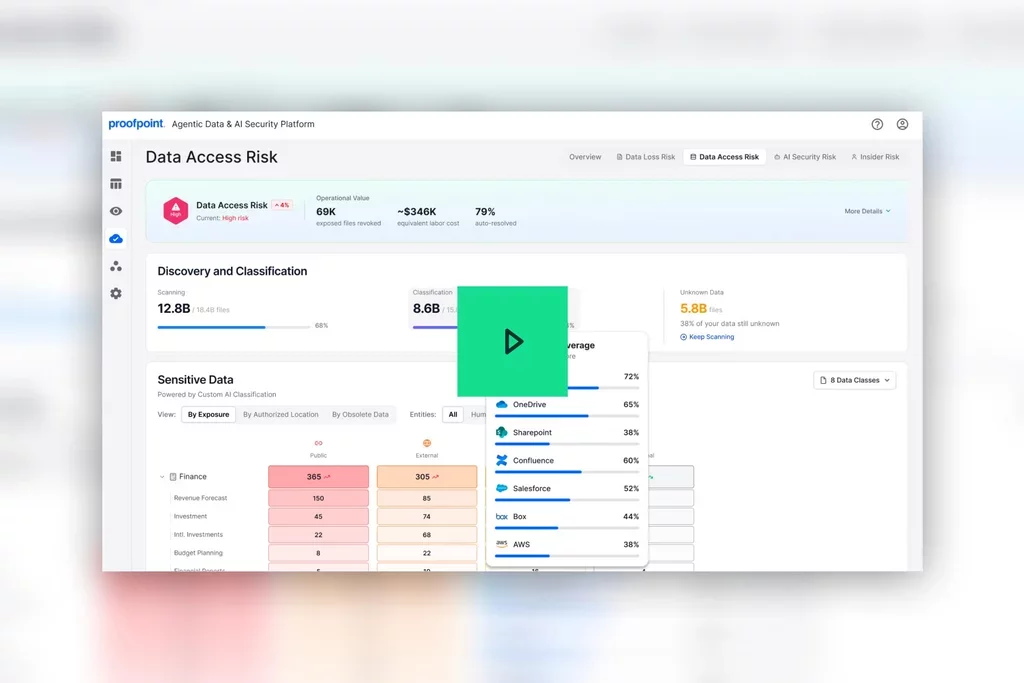
Discover and remediate overshared sensitive content and excess permissions before scaling AI adoption. 

Govern data use in sanctioned AI

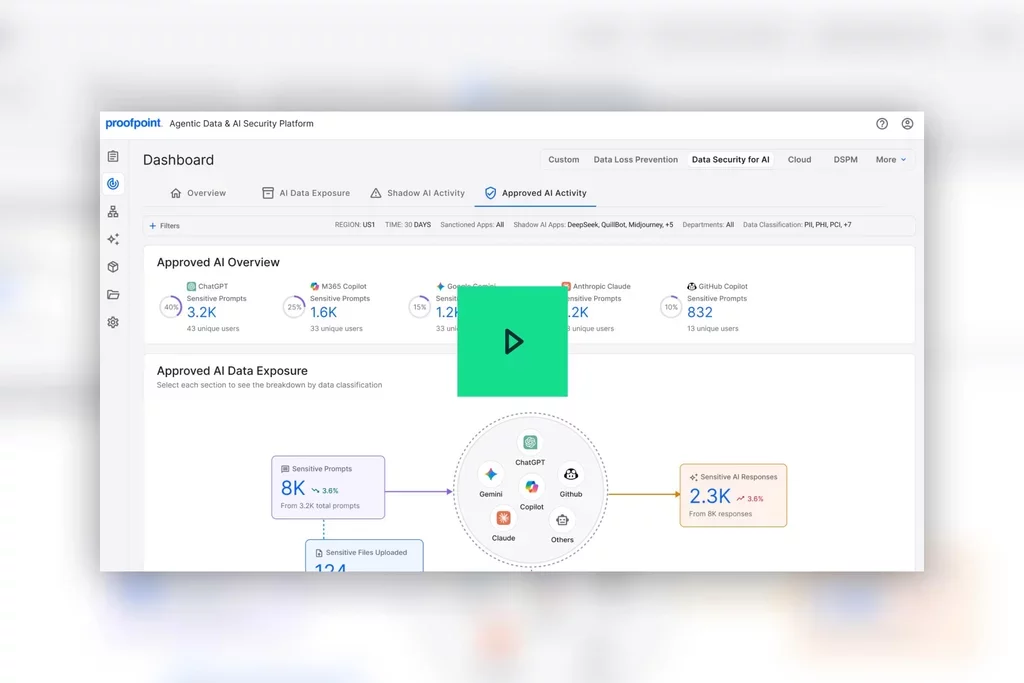
Monitor prompts, uploads, responses, and data access by approved AI applications.

Control data use in shadow AI

Detect and protect sensitive data shared with unsanctioned AI tools.

The AI Data Risk Landscape

AI adoption expands data exposure risk

Tools like Microsoft Copilot, enterprise GenAI, custom AI apps, and AI agents greatly expand access to sensitive data. Oversharing, excessive permissions, and unmanaged AI use can expose intellectual property (IP), regulated data, and confidential business data. Security teams need visibility into sensitive data exposure and control over how that data is used in prompts, uploads, model development workflows, and outputs.

60 %

of global CISOs believe GenAI poses a risk to their organization

Proofpoint, 2026.

68 %

of orgs using AI tools say shadow access or misuse exposed sensitive data

Metomic, 2025.

62 %

of orgs report lack of data governance as the main AI adoption blocker

Precisely, 2024.

AI Security Posture

Prepare sensitive data for enterprise AI adoption

Proofpoint Data Security Posture Management (DSPM), with integrated Data Access Governance, helps teams discover sensitive data, map who and what can access it, and remediate oversharing before AI adoption. Data Risk Map and AI classifiers help teams prioritize business-critical exposure and reduce risk across Microsoft Copilot, enterprise GenAI assistants, custom GenAI applications, and services like AWS Bedrock and Azure OpenAI.

Features

Identify regulated, proprietary, and business-critical data with AI-powered classification.

Map risk by data sensitivity, access, and movement between repositories, users, SaaS and AI apps, and external locations.

Find excessive permissions, public links, and risky sharing configurations.

Engage content owners to remove unnecessary access.  

Prioritize the most exposed high-value data stores.

Assess AI data exposure against GDPR, NIST, HIPAA, SOC 2, and the EU AI Act. 

01 04

Shadow AI Data Security

Discover and control data use across unsanctioned AI

Proofpoint Data Security for AI discovers data use and user activity across shadow AI and protects sensitive data in prompts, uploads, and clipboard activity. With visibility into AI data use, data controls, user-risk context, and investigation evidence, teams can reduce risk without blocking innovation.

Features

Identify user activity across hundreds of AI websites and desktop apps.

Detect confidential information shared with unsanctioned AI tools.

Redact sensitive data before it’s included in AI prompts.

Block, revoke, or restrict access to unauthorized third-party AI apps.

Correlate AI activity with insider risk indicators.

Capture activity context and evidence for security investigations.

01 04

Why Proofpoint

Proofpoint Data Security vs. basic AI access controls 

CapabilityBasic AI Access ControlsProofpoint Data Security
AI readiness and data posture Do not assess data readiness or oversharing risk  Maps sensitive data, excessive permissions, and AI-accessible exposure before deployment 
Sanctioned AI governance Track access mainly within approved apps  Monitors prompts, uploads, responses, and AI-driven data access while identifying and remediating AI misconfigurations 
Shadow AI discovery and control Use broad allow or deny policies  Identifies sensitive data use in unsanctioned AI tools and applies block, warn, redact, or allow controls 
Sensitive data protection Often allow or block access without inspecting data context  Detects, blocks, or redacts sensitive information before it is exposed to AI tools 
Custom LLM and RAG governance May broadly allow or deny access, but lack visibility into data used in AI development workflows  Governs sensitive data used in services such as AWS Bedrock and Azure OpenAI, as well as RAG, model training, and fine-tuning workflows 
Business-specific classification Rely on predefined patterns and generic categories  Uses AI classifiers to identify proprietary content consistently across Proofpoint DSPM, Data Access Governance, Enterprise DLP, and Data Security for AI 
Investigation evidence Offer limited evidence for analyst review or CISO reporting  Captures prompts, responses, screenshots, policy matches, and exportable reports 
Two technology professionals reviewing information together on a desktop computer.

Unified Platform

Protect and govern GenAI use and sensitive data

Combine DSPM, Data Access Governance, Enterprise DLP, and Data Security for AI to support AI readiness, sanctioned AI data governance, and shadow AI controls in one comprehensive platform.

Accelerate AI readiness with expert services 

Get expert guidance to assess data exposure, reduce oversharing, and support safe AI adoption.

Explore Premium Services

Request a Demo

Prepare data for AI and protect sensitive data across approved and shadow AI. Request a demo today.

Frequently Asked Questions

Generative AI data security protects sensitive data as organizations adopt AI applications, assistants, agents, and custom AI models. It helps prepare data for AI, governs how AI accesses and uses sensitive information, and continuously monitors prompts, AI output, and user activity. Together, these capabilities reduce the risk of data exposure across sanctioned and shadow AI while supporting secure AI adoption.

Organizations become AI-ready by discovering sensitive data, classifying business-critical information, and remediating oversharing before deploying AI. DSPM and Data Access Governance help ensure AI systems, copilots, agents, and custom LLMs only access approved data sources. This reduces risk and helps accelerate AI initiatives.

Organizations should continuously monitor prompts, file uploads, AI output, and data access in approved AI applications. They should also detect risky behavior, enforce data protection policies, and retain investigation evidence. Regular audits help strengthen AI data governance without disrupting productive AI use.

Organizations should discover unsanctioned AI applications, monitor how employees use them, and inspect prompts, uploads, and clipboard activity for sensitive data. Risk-based controls such as block, warn, and redact actions help reduce data exposure while supporting safe AI adoption.

AI data governance helps organizations control how sensitive data is accessed, shared, and used throughout the AI lifecycle. It supports regulatory compliance, protects data integrity, and helps ensure AI applications use trusted data. Strong governance also reduces the risk of unintended data exposure.

An enterprise AI data security solution should prepare data for AI, continuously monitor AI activity, govern access to sensitive data, inspect prompts and AI output, and enforce data protection policies. It should also provide investigation evidence and support regulatory compliance across the AI lifecycle.