
Part 3 of 4: Dynamic Protection: When Controls Move With the Risk
Why insider risk and data protection teams are coming together, and why the full user risk lifecycle changes what good protection looks like.
The fastest way to lose confidence in a data protection program is to block something the business needed to do. Anyone who has run DLP knows the sequence: a rule fires on a legitimate transfer, an exception gets written, and after enough false positives, policies slide into monitor-only mode. Protection that doesn't fit the moment doesn't protect anything for long.
Part 1 gave us a shared language through the Insider Threat Matrix™. Part 2 gave us the evidence chain, with sentiment analysis surfacing motivating factors before anything moves. Part 3 asks: what can we do with that context before something happens?
That's dynamic protection. Visibility and controls scale with the risk you can actually see, land where they belong, stay out of everyone else's way, and step back down on their own once the risk has passed.
Static rules have a context problem
Traditional DLP asks: should this data go there? Those controls remain essential; they catch accidental loss and set the baseline. Insider risk adds a second question: should this person be doing this, right now?
Picture a salesperson exporting 2,000 customer records during an approved territory change. Completely normal. Now a second salesperson does the identical export. Over the past few weeks they've been messaging a competitor, told a coworker they plan to leave, and asked an AI assistant to rewrite a resignation letter. HR knows none of this. No notice has been given. Then the records go out.
The content hasn't changed. The context has, weeks before any formal leaver flag existed. A static rule can only block both people or allow both. Neither is satisfying.
Insider risk and data protection teams are meeting in the middle
Should data protection and insider risk become one team? I care less about the org chart than whether the policies work together, because both teams end up looking at the same thing: data moving somewhere it shouldn't. DLP is the tool the data protection team uses to govern that movement. Insider risk adds the person, behavior, and timing around it.
In practice, the two teams work the same egress events from opposite directions. DLP triage works the alert with just enough context to clear it or escalate it. Insider risk runs proactive investigations across those same events in a larger data set: user-risk context, behavioral history, and sentiment signals. That view matters most when the rules fall short and an insider finds a tactic the controls never anticipated. Anything squarely in DLP's remit goes back to that team. They meet in the middle, working from one evidence chain instead of half a picture each.
That only works if both teams are fed from the same source, which is why the technical foundation matters more than the reporting line. Three capabilities make it real.
- One agent, flexible enough for both programs. A single endpoint agent captures the file-movement telemetry the data protection team needs for DLP and, when a trigger fires, the behavioral and forensic depth insider risk needs. Not two agents competing for the same endpoint and producing two versions of the same event. One deployment, one data stream, one timeline.
- Program-scoped access, enforced by policy. Each program defines its scope, and role-based access policies enforce it. The event exists once, but a DLP analyst sees what the DLP charter allows and an insider risk analyst sees what the insider risk charter and its privacy obligations allow. Scope is protected by policy, not by trust.
- Behaviorally aware protection decisions. Because the DLP policy and the user-risk context sit on the same agent, the protection decision can weigh both at the moment of action: what the content is, where it's going, and whether this person, right now, warrants a warning, a delay, or a block.
This works for customers because nobody has to give anything up. Each team keeps its own workflow and its own scope, but the evidence doesn't fragment. A DLP alert that escalates to insider risk arrives with its context attached rather than as a ticket number and a hope, and the organization can show, policy by policy, who saw what and why.
Think ladder, not light switch
Dynamic protection isn't a jump from "allow" to "block." It's a ladder with a ground floor.
The ground floor is the baseline policy for everyone: lightweight visibility into file movement and egress, plus regulatory controls that never switch off. It is deliberately not full-depth collection, because most people, most of the time, don't warrant it.
The first rung is enhanced monitoring: work continues, the program pays closer attention. Next come soft controls: a warning, a justification prompt, a short delay, or a redirect to an approved app. At the top are hard controls for moments where confidence and impact justify stopping the action.
The data matters too. AI classifiers recognize source code where pattern matching struggles. A code paste into an AI tool is routine for one developer; paired with elevated user risk or preparation-stage behavior, it deserves a different response. Understand the data, understand the person, apply the right friction for that moment.
Enhanced monitoring: depth when it's needed, not all the time
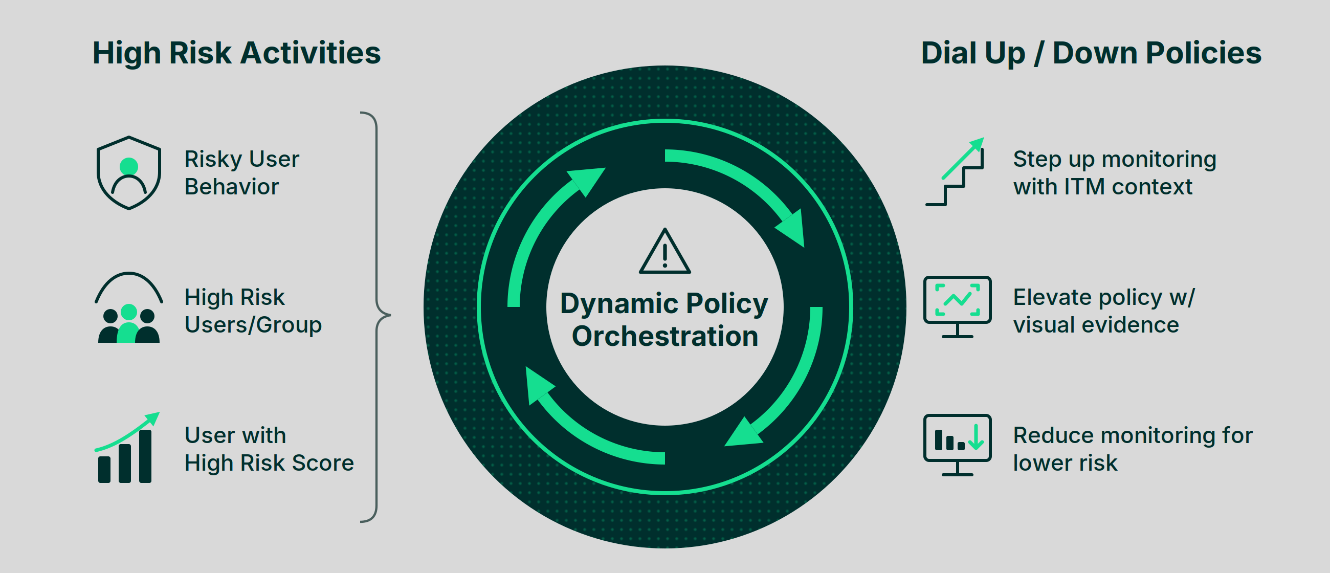
Enhanced monitoring is triggered, time-bound, and self-resetting. A trigger defined in organizational policy lifts a person from the baseline file-movement policy into a deeper collection tier for a set window. During that window, events ship with forensic detail on the file and its lineage, surrounding endpoint and cloud activity, and screen captures of the moments that matter. When the window closes and nothing has developed, the person drops back to baseline automatically. No one has to take them off a watchlist.
Triggers come from two directions: user risk and behavior (a download spike, a first-time upload to an unsanctioned destination, a dismissed warning, a risk-score threshold) and user group and lifecycle (joiners in their first weeks, leavers from notice through departure, contractors nearing contract end, role changes, anyone under an HR process). Elevating a group is a policy decision, not a judgment about an individual.
It supports privacy and prevents over-collection. Blanket screen capture is hard to justify to employees, workers' council, or regulators, and most of it is never viewed. Tying collection to policy-defined behaviors means the program can show why someone was elevated, for how long, and what was captured. Screenshots exist because a documented trigger fired, not because someone was curious.
Auto step-down keeps the elevated population honest.
The same triggers drive controls. What lifts someone into monitoring also arms a soft control on their next data move and, if evidence builds, a hard block. Monitoring and protection read from one evidence chain, so they never drift apart.
This is where Part 2 pays off: motive and preparation signals are often what lift someone into enhanced monitoring, so evidence accumulates while there's still time to act. The person isn't flagged as a threat; the program is simply paying closer attention, for a defined period and reason.
Soft friction can tell you something a hard block can't
A warning doesn't just interrupt an action. It creates evidence. Someone tries to upload sensitive material somewhere it shouldn't go and gets a prompt. Maybe they realize the mistake and stop. Maybe they justify it and continue through an approved workflow. Maybe they try to route around it. The first action could have been negligent. What happens next tells you far more.
Within defined thresholds, and where data and impact allow, you can give a situation room to develop: friction protects against the immediate risk while you watch. Hard-blocking the first questionable action can erase the context investigators need. That isn't license to let dangerous activity play out; crown-jewel data or high-confidence infringement still gets an immediate hard block, governed by HR/Legal-aligned thresholds. Sometimes the right protection is a wall; sometimes it's a speed bump that also tells you where someone's headed.
Watching the ladder move: one case, five days
Jake, a software engineer, gives two weeks' notice on a Monday. HR's system flags a known leaver catalyst, and the platform moves him up one rung to enhanced monitoring for his notice period. His access doesn't change; his events just ship with more depth.
Wednesday, his download volume spikes well above baseline. Combined with the resignation, that widens the net: more endpoint and cloud activity is captured, including screen captures around the flagged transfers, so an analyst can see what was pulled and where.
Friday, Jake pastes a chunk of source code into an AI tool. Normally routine, but not for his current risk profile. A soft control asks for a business justification. Jake closes the warning, switches browsers, and tries again.
That move, not the paste, changes everything. Circumventing a warning looks deliberate: the risk score jumps, repository access is expanded for review, and further attempts to move source code externally are hard-blocked. No single moment—resignation, download spike, code paste—justified a hard block on its own. Together, they told a different story.
Now imagine the other version. Wednesday's spike is a sanctioned handover, Friday passes quietly, nothing escalates. Jake's window expires with his notice period, collection stops, and he leaves at baseline, no decision required. That's the ladder working the other way.
The goal isn't more blocking. It's more precise protection.
"Dynamic protection" can sound like an excuse for increasingly aggressive controls. It should be the opposite: less friction for most people, more precise friction where the evidence supports it. A narrowly applied control is far easier to live with than another global policy that catches legitimate work until everyone wants an exception.
That precision requires governance, because richer evidence brings responsibility. HR and Legal need alignment on what raises a risk tier, how long elevation lasts, what each tier collects, and what it permits. Thresholds are defined, review is auditable, screen captures stay masked until the right escalation point, and access follows the program-scoped policies above.
DLP doesn't disappear. It gains the context it never had, so the strongest controls go only where they're warranted—more practical than writing more rules.
Next up: surfacing the risk you don't know about
Part 1 gave us the language. Part 2 gave us the evidence chain, with sentiment analysis surfacing motivating factors. Part 3 showed how that evidence lets protection adapt while risk is fluctuating.
One piece remains: what happens when the system can start detecting, investigating, and packaging the case for you?
Part 4 covers agentic triage and investigations end to end: connecting signals across the full lifecycle, to surface emerging insider risk so analysts know where to look, rather than relying solely on a referral that’s often reactive. The need is simple: use all of this rich data to work smarter and surface risk faster, because most teams aren’t getting more people; resources are flat at best, often shrinking in the age of AI adoption.
Learn More
Watch our recent webinar with Insider Threat Matrix co-founders, James Weston and Joshua Beaman.